Key takeaways
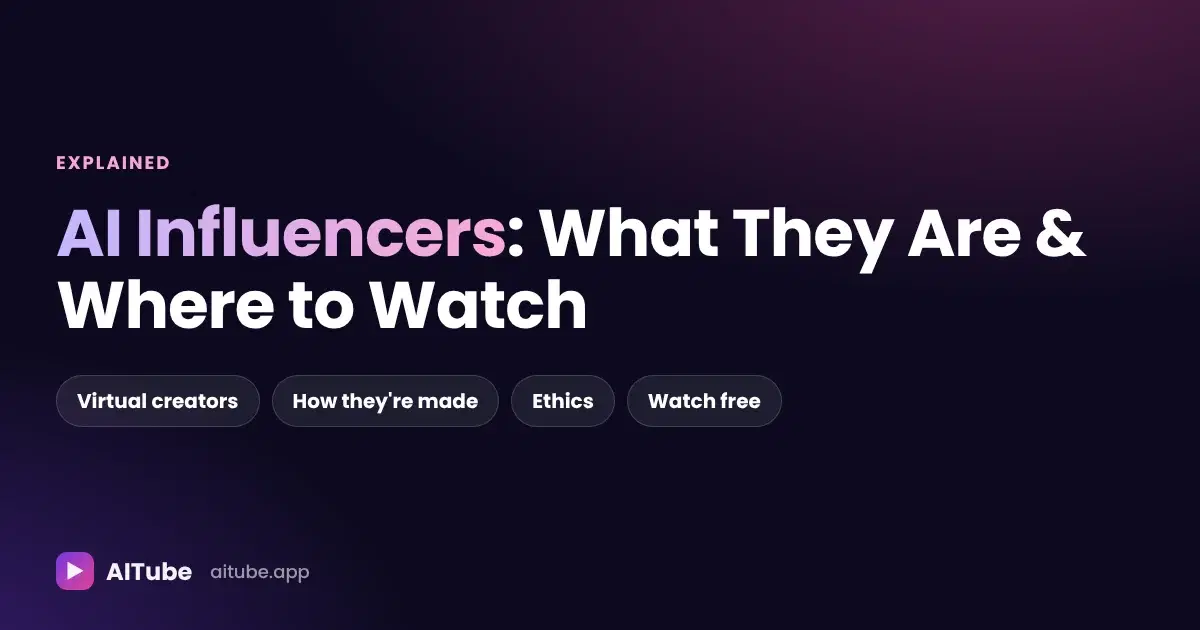
AI influencers (virtual influencers) are invented characters created with AI image, video and voice tools.
They're popular because they can post constantly, appear anywhere, and never break character.
Good AI influencers are clearly labelled as AI and are original characters, not copies of real people.
AITube has a dedicated AI Influencers category, and creators can build their own AI influencer with AI Studio and Faceless.
Scroll through any social feed long enough and you'll meet someone who isn't real: a travel vlogger who never boards a plane, a fitness coach generated frame by frame, a fashion icon who exists only as pixels. These are AI influencers, and they've become one of the most talked-about trends in online video.
Some people find them fascinating, others find them unsettling, and plenty of creators see them as a new creative format. This guide explains what AI influencers are, how they're made, why they're growing, the ethical questions around them, and where you can watch AI influencer videos.
What is an AI influencer?
An AI influencer, also called a virtual influencer or digital creator, is a character created entirely with artificial intelligence that publishes content and builds an audience the way a human influencer would.
A typical AI influencer has:
A consistent appearance: the same face, hairstyle and style in every post.
A personality: a backstory, interests, a sense of humour and a recognisable way of talking.
A voice: usually an AI-generated voice that stays the same across videos.
A niche: fashion, travel, fitness, gaming, comedy, tech, food or storytelling.
A channel: regular posts, Shorts and sometimes longer videos.
Behind every AI influencer is a human creator, or a team, who writes the content, designs the character and decides what they say.
How AI influencers are made
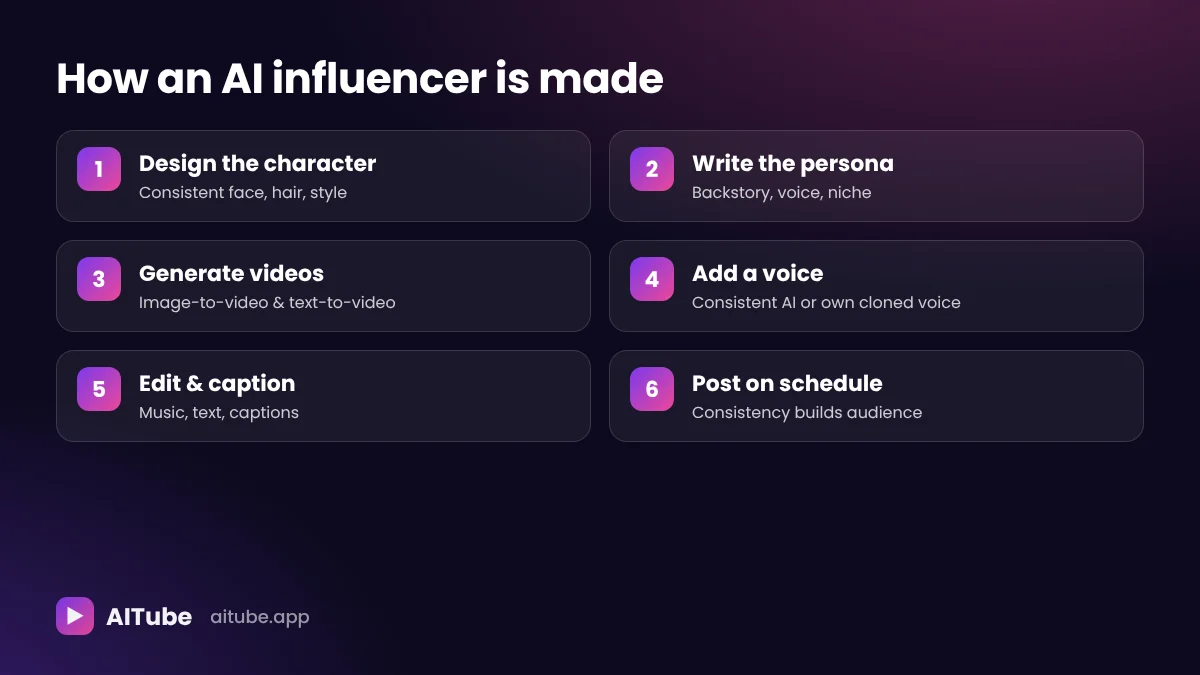
Creating an AI influencer combines several AI tools:
Character design. The creator designs the look with AI image tools and writes a detailed description, covering face, hair, outfits and style, that is reused every time.
Personality and script. A backstory, tone of voice and content plan. Every video still needs a script.
Video generation. AI video models animate the character in different scenes, from city streets to studios, using image-to-video or text-to-video.
Voice. An AI voice gives the character a consistent sound. Some creators use a cloned version of their own voice.
Editing and captions. Clips are cut together with music, text and captions, just like any influencer video.
Publishing on a schedule. Consistency matters as much for AI influencers as for human ones.
Why AI influencers are growing
They never run out of content. An AI influencer can appear in Tokyo on Monday and on Mars on Tuesday, without travel, sets or schedules.
They're endlessly customisable. Creators can design a character for a specific audience, niche or aesthetic.
They never break character. For storytelling channels, a consistent persona makes it easy to build long-running narratives.
Low production cost. Compared with photo shoots and filming, AI generation is cheap and fast.
Pure creativity. Some AI influencers are less about selling products and more about art: surreal characters, fictional worlds and ongoing stories told through a persona.
AI influencers vs human influencers
AI influencer | Human influencer | |
|---|---|---|
Who appears on screen | An invented AI character | A real person |
Who runs the channel | A human creator or team | The person themselves |
Locations | Anywhere, including fictional worlds | Wherever they can travel or film |
Posting frequency | Limited mainly by ideas and editing time | Limited by time, energy and logistics |
Authenticity | Built through story and personality | Built through real life and experience |
Risks | Unclear labelling, unrealistic standards | Burnout, privacy pressures |
Neither replaces the other. Human influencers offer lived experience; AI influencers offer imagination without limits. Many viewers enjoy both, as long as they know which is which.
Why some people find AI influencers unsettling
It's worth acknowledging the other side. Some viewers find AI influencers uncomfortable, especially when they look almost human. The usual concerns are that people might not realise a character isn't real, that perfect AI faces could set unrealistic expectations, and that AI characters might be used to mislead or to promote products dishonestly. These are fair worries, and they're exactly why labelling, consent and honest promotion matter. When an AI influencer is clearly presented as a creative character, most of the discomfort fades and what's left is a new kind of storytelling.
Types of AI influencers
Type | What they post | Why viewers follow |
|---|---|---|
Lifestyle and fashion | Outfits, routines, aesthetic Shorts | Visual style and aspiration |
Travel | "Visits" to real and imaginary places | Escapism and spectacular scenery |
Comedy and character | Sketches, reactions, running jokes | Personality and humour |
Storytelling | Episodic stories told by a persistent character | Ongoing plots and lore |
Education and explainers | Tips, facts and how-tos delivered by a persona | Friendly, consistent presenter |
Music | AI singers and performers | Songs and music videos |
Fantasy and sci-fi | Characters from invented worlds | World-building and imagination |
The ethics of AI influencers
AI influencers raise real questions, and the best creators take them seriously.
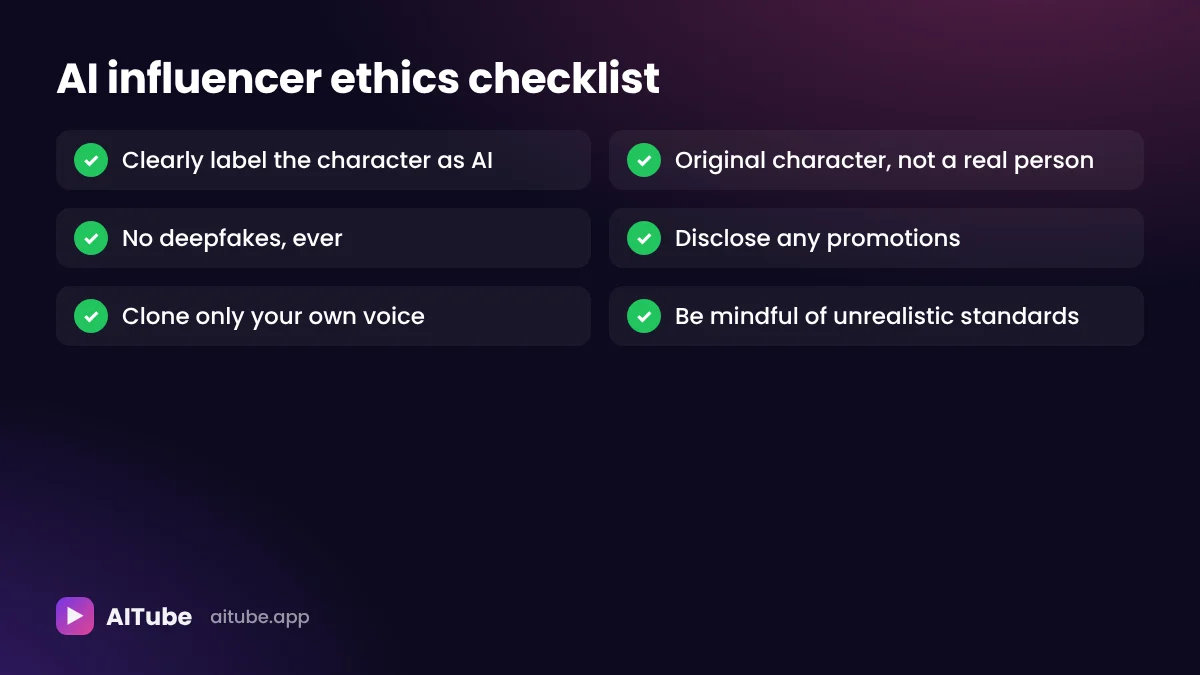
Transparency: viewers should know they're watching an AI character. Clear labelling builds trust; hiding it erodes it.
No real people without consent: an AI influencer should be an original character, not a copy of a real person's face or voice. Deepfakes of real people are harmful and widely prohibited.
Honest promotion: if an AI influencer promotes a product, that should be disclosed, just as it would be for a human creator.
Realistic standards: AI characters can look impossibly perfect. Responsible creators are mindful of the beauty and lifestyle standards they set.
Voice rights: clone only your own voice, or one you have explicit permission to use.
On AITube, only AI-made videos are allowed, which means AI content is clearly labelled by default. Creators can also list the AI model they used. The rules require creators to have the right to share what they upload, with no reposts and no real people without consent, and deepfakes and non-consensual imagery are prohibited.
Where to watch AI influencer videos
AITube's AI Influencers category
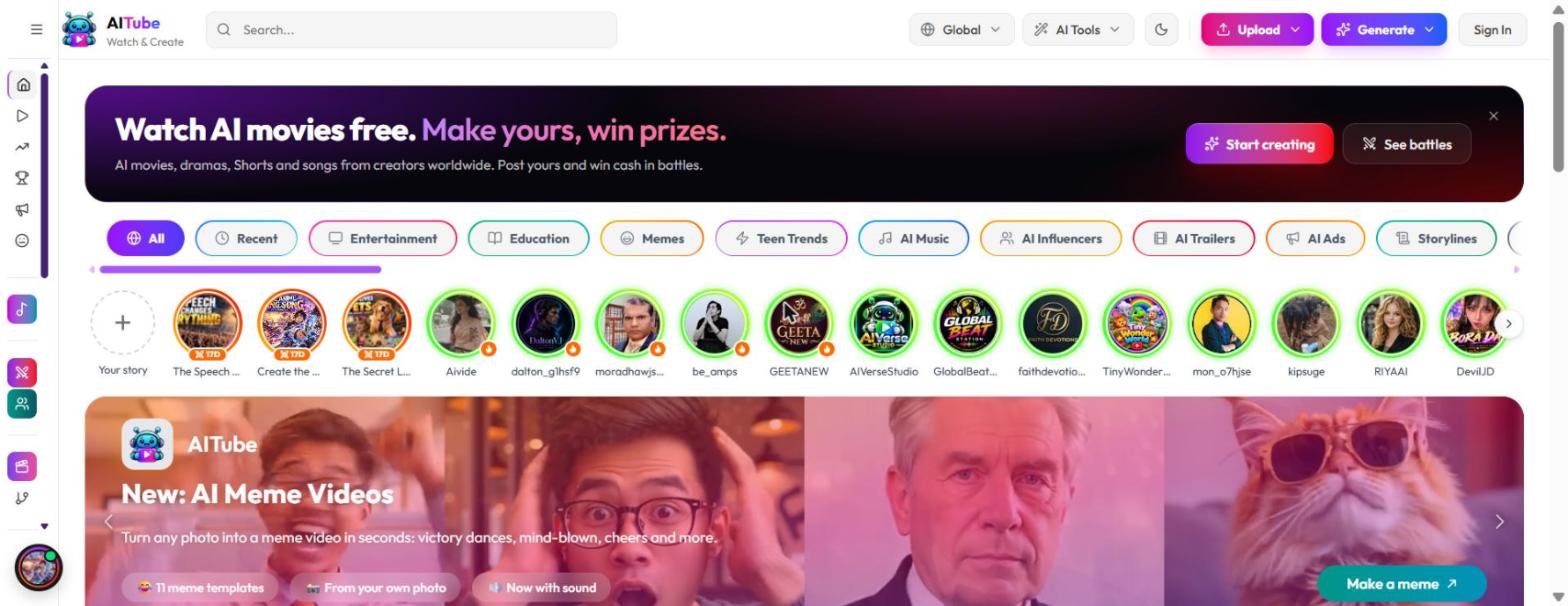
AITube is an AI-only video platform with a dedicated AI Influencers category in its main category bar. It's one of the easiest places to discover virtual creators, because every video on the platform is AI-made and labelled as such.
Free to watch, no account needed.
AI Influencers category for virtual personalities and character channels.
Shorts for vertical influencer-style clips.
Trending to see which AI characters are getting attention right now.
Filter by AI model to explore how different models handle consistent characters.
Follow your favourite characters with a free account, so new posts appear for you.
Web, iPhone and Android.
Other platforms
AI influencers also post on general social platforms, but there it isn't always clear which accounts are AI. Labels vary, and some accounts don't disclose it at all. On an AI-only platform, you always know.
How to watch AI influencers on AITube
Open AITube
Go to aitube.app or open the AITube app on iPhone or Android.
Tap AI Influencers
Choose the AI Influencers category from the bar at the top of the feed.
Scroll Shorts
Many AI influencer clips are vertical and appear in the Shorts feed.
Check Trending
Discover which AI characters are popular this week.
Follow characters you like
Sign up free to follow channels and get their new videos.
How to create your own AI influencer on AITube
If you'd rather build one than watch one, AITube has the tools in one account:
AI Studio: generate scenes of your character with models such as Kling 4.0, Veo 3.1, Seedance 2.0/2.5, MiniMax H3, Gemini Omni, Grok Imagine, Wan, PixVerse V6 and Runway Gen-4.5. The credit cost is shown before you generate, failed generations aren't charged, and there's no watermark.
Instant Effects and AI Meme Videos: turn a still image of your character into short effect or reaction clips.
AITube Faceless: turn a script into a narrated video with 97 voices, captions in 11 languages, and voice cloning on Creator and Pro plans, useful for explainer-style AI presenters.
Optional AI presenter: Faceless supports an optional lip-synced AI presenter.
Free publishing: your videos go into the feed and search, vertical videos appear in Shorts, and followers are notified.
Tips for building a memorable AI influencer
Start with a clear niche. "Funny AI chef who reviews impossible dishes" beats "AI lifestyle influencer."
Write a character bible. Appearance, personality, backstory, catchphrases. Reuse the same description in every prompt.
Keep the look consistent. Inconsistent faces are the fastest way to lose the illusion. Start from a reference image when you can.
Give them a voice. One consistent AI voice, ideally your own cloned voice or one you have rights to.
Be upfront that they're AI. It's the honest choice, and audiences are often more interested when they know.
Post consistently. On AITube, a daily streak of 7 days or more boosts your videos in the feed.
Can AI influencers make money?
They can. On AITube, AI influencer channels can earn the same ways as any creator:
Ad revenue share: approved creators receive 55% of ad revenue on their videos' watch pages. Requirements are 150 followers, 300 public video views in the last 60 days, 2 public videos and a one-time identity check for the human behind the channel.
Prompt Battles: enter themed challenges for cash or credit prizes, with no follower minimum.
Creative Reuse: let others license or download your videos for a fee.
Affiliate program: earn 15% of Creator or Pro payments from people you refer, for their first 6 months.
The future of AI influencers
AI influencers will keep getting more convincing as models improve character consistency, motion and voice. Expect more interactive characters, more storytelling channels built around a persistent persona, and more brands experimenting with virtual spokespeople. Expect stronger norms around labelling, too. The creators who will stand out are the ones who pair the technology with real creativity: memorable personalities, good writing, and honesty about what their characters are.
Frequently asked questions
Meet the AI creators
AI influencers are one of the strangest and most creative corners of online video. Watch a few, and you might end up creating your own.