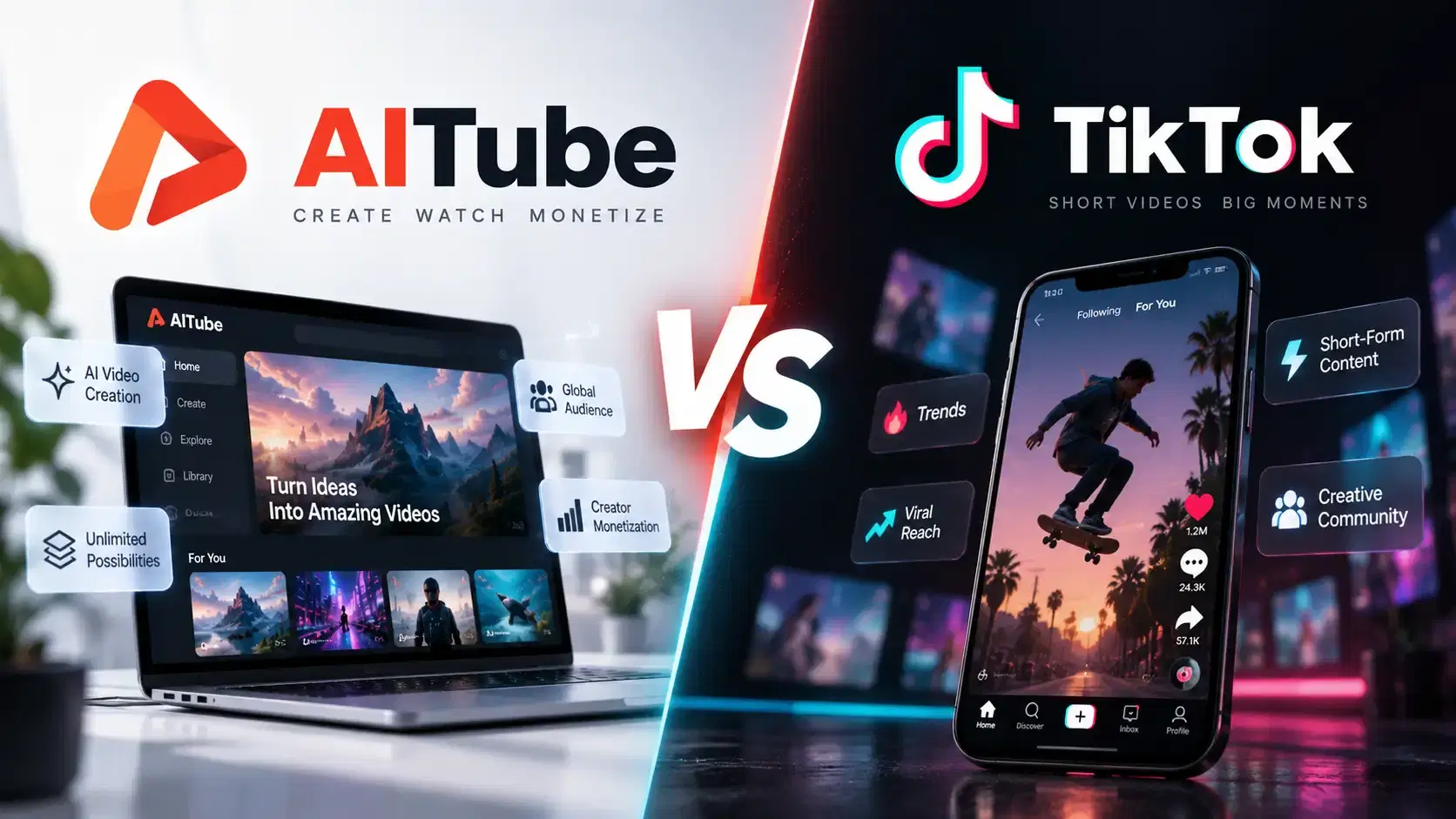
If you type an idea into a box and want a finished video on the other side, then a place to publish it, grow an audience, and get paid, you are really choosing between two very different kinds of product. AITube and TikTok both sit under the phrase "AI video," but they solve different problems. Our team researched both platforms and put this guide AItube vs Tiktok together for you, below you can find all the details.
TL;DR: AITube is an AI-native platform. It generates the video for you from a prompt or script, then lets you publish, get discovered, compete, and earn inside a feed built specifically for AI content. TikTok is the largest short-video social network on earth, with over a billion monthly active users, but it is a distribution app first. You provide the finished video, while AI-generated clips are clearly labeled. Viewers can also choose to see fewer AI-generated videos in their feed.
Choose AITube if your whole workflow is AI, from generation to publishing to monetization, and you want an audience that came to watch AI content. Choose TikTok if raw reach is the single most important thing and you are willing to produce, label, and adapt content to a platform where AI is one category among many.
Neither platform is better for everyone. The right choice depends on what you want the platform to help you do.
AITube vs TikTok: Core Difference
TikTok is a social network that permits AI content. AITube is a platform built around AI content. That distinction drives almost every practical difference below. On TikTok, AI clips compete for attention with videos of people dancing, cooking, and doing comedy. Realistic AI videos must have an “AI-generated” label, and viewers can choose to see less AI content in their feed. On AITube, AI generation is the front door, the feed is AI content by default, and the community showed up expecting exactly that.
AItube vs Tiktok: Generate the Video
Turn a written idea into a finished, publishable video without learning an editor.
AITube does this natively. Its AI Shorts Studio turns a prompt or a full script into vertical video, with the AI writing or interpreting the script, building scenes, adding a voiceover, and generating captions in one workflow. You can pick from multiple AI models and quality tiers, described on the site as Standard (listed at 20 credits per scene), Premium for higher quality, and Cinematic for maximum detail, and you see the estimated credit cost before you generate. Extra creation tools include consistent AI characters that stay recognizable across a series, a caption generator with bold, minimal, highlighted, and karaoke styles, and talking-avatar videos. An AI Movie Maker and long-form video mode are listed as coming soon.
TikTok's main app does not do this. TikTok is where you upload and distribute a video, not where a text prompt becomes one. TikTok does have a generative AI suite called Symphony, but it is a separate product. Symphony launched in 2024 as an advertiser tool, and in April 2026 it opened its AI video features to individual creators. It is free to use with a TikTok for Business account and is powered by ByteDance's Dreamina Seedance model, offering text-to-video, image-to-video, AI dubbing, and digital avatars. Two things are important here. Symphony is made for marketing and product content, not open creative storytelling. Any qualifying content is automatically labeled as AI-generated, and you cannot remove the label.
Video Generation Models.
A detail that matters more than it first sounds: which AI model actually generates your video.
AITube gives you more choice. Its Shorts Studio offers several AI video models and quality levels, including Standard, Premium, and Cinematic. Before you create a video, you can choose the model and quality level that fit your goal and budget. You can also see the estimated credit cost before you start.
AITube videos use different AI models, and published videos can show which provider was used. Since each model has different strengths, you can switch between them based on what you need. You can use the Cinematic level for an important video and a cheaper option for videos you make every day. This gives you more control over both quality and cost.
TikTok does not offer that choice. Its Symphony generation suite runs on ByteDance's own Dreamina Seedance model, and that is the engine you get. For many marketing videos, this is more than enough. But if you need a specific look, motion style, or AI model, using just one fixed model can limit what you can create.
AItube vs Tiktok: Publish and Distribute
Get the finished video in front of people, ideally in more than one place, without manual re-uploading.
AITube publishes to its own feed and connects YouTube and TikTok inside the same workflow, so one creation can go to three destinations.Its Auto Series feature stands out. You choose a topic, number of episodes, style, and daily or weekly schedule, and AITube creates and publishes each episode on time. This keeps your channel active without needing to work on it every day. For creators whose growth strategy is consistency, publishing that runs itself is a real advantage.
TikTok is, unquestionably, the stronger pure-distribution engine. With over a billion monthly active users and a recommendation system famous for surfacing new creators, nothing on this page matches its raw reach. But two facts complicate the picture for AI creators specifically. First, realistic AI-generated content must carry an "AI-generated" label, and TikTok detects it automatically through C2PA content credentials and watermarking even when a creator does not self-disclose.
TikTok has reported that over a billion videos on the platform now carry AI labels. Second, and more consequential, TikTok rolled out a feed control that lets viewers reduce how much AI-generated content they see, found under Content Preferences and Manage Topics. Your AI content can reach an enormous audience, but part of that audience is actively turning the dial away from it.
AItube vs Tiktok: Build an Audience as an AI Creator
Turn views into a following that came specifically for what you make.
This is where the platform philosophies diverge most sharply. On AITube, every viewer is there for AI content. The feed is organized into AI-native categories such as AI Music, AI Influencers, AI Trailers, AI Anime, animation, and short films, and the community, the verified-creator system, and the discovery surface all assume AI is the norm. An audience that opted in to AI content is more likely to reward it with likes, comments, and follows.
On TikTok, your AI content reaches a general audience, which is both a strength and a weakness. The upside is scale and crossover potential. The downside is that a meaningful slice of that audience has told the platform, through the reduce-AI slider and "not interested" signals, that they want less synthetic content. You are building a following inside an environment where your entire content category can be dialed down by the viewer.
AITube vs Tiktok: Compete and Get Paid
Earn from the content you make, and ideally have a path to do so before you have a massive following.
AITube frames monetization as central rather than an afterthought. Its Prompt Battles feature lets AI video creators join challenges by submitting their videos. Other users vote on the videos, and winners can earn cash, credits, and other prizes. It also gives creators a chance to get noticed without having a large audience. Beyond that, AITube also has an ad revenue share program that pays creators a set percentage of advertiser spending. It aims to be an “AI Creator Economy” that brings video sharing, discovery, community, and monetization together in one place.
TikTok has the more established, more documented monetization stack, but with a high bar. The Creator Rewards Program requires at least 10,000 followers and 100,000 video views in the past 30 days. You must also be 18 or older, have a personal account in good standing, and live in an eligible country such as the US, UK, Germany, Japan, South Korea, France, Mexico, or Brazil. Critically, it only rewards videos that are at least one minute long, and reported rates run roughly $0.40 to $1.20 per 1,000 qualified views depending on niche and audience country. Below that threshold, creators can use LIVE Gifts (available from 1,000 followers), TikTok Series, the TikTok Shop affiliate program, and the Creator Marketplace for brand deals.
Who Owns What You Make
Before you build a whole content library on any platform, it is worth knowing who controls it, because the license terms decide how freely your work can be reused.
TikTok's terms are explicit and broad. Under its Terms of Service, you still own your content. However, when you post it, you give TikTok a worldwide, royalty-free license to use, change, copy, and share your content. TikTok can also transfer or give this license to others. It can use your content to run and improve the platform and develop new technologies, including machine learning models. You also grant every other user a license to reuse your content through platform features, and that license can continue even after you delete a video if it has already been incorporated into someone else's content. This does not take away your ownership. However, by uploading your content, you give the platform and its users broad rights to use it under terms you cannot change. Your videos, voice, and likeness may also be used to train AI systems.
AITube's public monetization policy frames the relationship differently, as a partnership in which creators earn a revenue share from their own content rather than a broad content grab. That is a friendlier starting point, but you should still read the fine print. AITube’s Prompt Battles terms give AITube and its sponsors broad rights to use contest entries. They can also allow others to use them. In some cases, AITube or the sponsor may own new work created from those entries.
That is standard for prize competitions, but it is competition-specific, so if you enter Battles, read those terms first.
The practical takeaway applies to every platform: you generally keep copyright, but each platform's license controls the reuse. Read the terms of whichever platform you commit to, and confirm the ownership and commercial-use rights for the generated videos you plan to monetize.
Aitube vs Tiktok: Advertising: Making Ads, Running Ads, and Earning From Ads
"Advertising" means three different things depending on which side of the screen you sit on. Here is how AITube and TikTok compare across all three, because a creator, a video maker, and a brand will each care about a different one.
Earning from ads as a creator
This is where the gap is widest, and it favors AITube for anyone who is not already famous. AITube runs a native ad revenue share: when ads run on your content, you earn a share of advertiser spend based on valid impressions, views, and clicks after fraud checks. The published splits are 55% for video ads (pre-roll, mid-roll, and end-roll), 45% for Shorts ads shown in-feed, and up to 30% for thread ads in community posts. The eligibility bar is deliberately low: a verified account, at least 150 followers, 300 video views in the past 60 days, and at least 2 public videos. Payouts start at a $50 minimum, run monthly on NET-30 terms, and are processed through Stripe or Payoneer.
Now compare TikTok. TikTok's main creator payout, Creator Rewards, is a per-view rate rather than a direct cut of ad spend, and it requires 10,000 followers plus 100,000 views in 30 days. TikTok's actual ad-revenue-share product is TikTok Pulse, which splits ad revenue 50/50 with creators, but it is reserved for creators with at least 100,000 followers whose content ranks in roughly the top 4% of the platform on a given day. Put plainly, TikTok's most generous ad share is gated behind fame, while AITube's opens at 150 followers.
Making ad creative with AI
If your goal is to produce ads rather than earn from them, both platforms offer AI tooling, but with different intent. AITube treats AI Ads as a first-class content category, and its Shorts Studio can turn a product idea or a script into an ad-style vertical video with voiceover, captions, consistent characters, and avatars, all inside the same workflow you use for everything else.
TikTok's answer is Symphony Creative Studio, and for pure ad creative it is powerful and purpose-built. It turns a product photo, a product URL, or a text brief into a TikTok-native clip, and it adds AI dubbing, digital avatars, and product-showcase modes. The trade-offs: Symphony is built around marketing rather than open creative expression, it is oriented to a TikTok for Business account, and every qualifying output is automatically labeled as AI-generated with no way to switch that label off.
Running and buying ads as an advertiser
This is TikTok's home turf, and it is not close. TikTok Ads Manager is a mature, self-serve auction platform with deep targeting, sitting on top of over a billion monthly active users. Beyond standard in-feed ads, brands can use Spark Ads to boost organic creator posts as ads, and Pulse to place ads directly after the top-performing content of the day. For a brand that wants scale and precise targeting right now, TikTok is one of the largest ad systems in the world.
AITube's advertising system is the other side of the same coin: advertisers pay, and creators receive the revenue share described above. It is native, contextual, and built for AI content, so ads run inside an environment where AI video is expected rather than filtered out. But it is a newer and far smaller marketplace, without the reach, targeting depth, or advertiser base of TikTok Ads Manager.
If you are a creator who wants to earn from ads without first building a massive following, AITube's low-barrier, defined-percentage revenue share is the standout, because it pays a clear 55% on video ads starting at 150 followers. If you are a brand that wants to reach the largest possible audience with precise targeting, TikTok's ad platform is unmatched. And if you want to make ad creative with AI, both deliver, with Symphony sharper for product ads and AITube better for keeping creation, publishing, and earning inside one loop.
Side-by-Side Comparison
FactorAITubeTikTok | ||
|---|---|---|
Primary purpose | AI video generation + publishing + community | Short-video social distribution |
Built-in text/script-to-video | Yes, core feature | No in main app; Symphony is a separate, marketing-focused tool |
AI model choice | Multiple models + Standard/Premium/Cinematic tiers, you pick | Single fixed model (Dreamina Seedance) |
Consistent AI characters | Yes | Not in the consumer app |
Auto-publish a scheduled series | Yes (Auto Series, daily or weekly) | No native AI series auto-publishing |
Multi-platform publishing | AITube, YouTube, TikTok from one workflow | Publishes to TikTok |
Audience reach | Growing, AI-native | Over 1 billion monthly active users |
AI content in the feed | The default, no penalty | Must be labeled; viewers can reduce it |
Content license terms | You keep ownership; revenue-share partnership framing | You keep ownership but grant a broad, sublicensable license including AI training |
Entry-level earning | Prompt Battles (cash, credits, prizes), no follower gate | LIVE Gifts from 1,000 followers |
Main monetization program | Ad revenue share + AI Creator Economy | Creator Rewards: 10k followers, 100k views/30 days, 1 min+ videos, eligible countries |
Ad revenue share to creators | Native: 55% video, 45% Shorts, up to 30% threads | Pulse 50/50 split, but only for top-4% content |
Bar to earn ad revenue | 150 followers, 300 views/60 days, 2 public videos | Pulse ad share needs 100k followers |
AI ad-creative tools | AI Ads category + Shorts Studio, in one workflow | Symphony Creative Studio, marketing-focused, auto-labeled |
Advertiser ad platform | Native, contextual, newer and smaller | TikTok Ads Manager: mature, huge reach, deep targeting |
Best for | Creators whose whole workflow is AI | Creators who want maximum reach and already produce video |
When Is TikTok Still the Right Answer?
TikTok wins clearly in three situations, and it would be dishonest to pretend otherwise.
First, when reach is everything. No AI-native platform can match a billion-plus monthly users and a recommendation engine designed to make unknown creators go viral overnight.
Second, when you already have a human audience. If your following came for your face, your voice, or your real-world skill, TikTok is where they are, and occasional AI clips ride on top of an audience you already built.
Third, when you want the broadest possible monetization stack and a mature advertising engine. Creator Rewards, Pulse ad-revenue share, Series, Shop affiliate, LIVE Gifts, and TikTok Ads Manager together form a range that AITube's newer economy does not yet match in breadth, even though AITube's ad revenue share is more accessible at the entry level.
If any of those three describe you, TikTok is the pragmatic choice, and pairing it with an AI generator for the actual creation step is a perfectly good workflow.
When Is AITube the Better Fit?
AITube is the stronger choice when the creation itself is the hard part, not just distribution. If you do not have a face to put on camera, editing skills, or hours to spend per video, a platform that turns a prompt into a finished, captioned, voiced short and can publish a whole series automatically removes the exact friction that stops most people from ever starting.
It is also the better fit when you want an audience that came for AI, an earning path that does not require 10,000 followers first, and one workflow instead of a stack of disconnected tools. You generate, publish, get discovered, compete, and distribute to YouTube and TikTok from the same place, rather than exporting from a generator and hoping a general social feed does not dial your content down.