A few years ago, "where should I post my AI video?" wasn't a real question. There was only one serious answer: upload it wherever the most people are. Today the answer is less obvious. AI video models like Veo, Kling, Seedance and Sora can produce cinematic clips in minutes. Millions of people are making AI trailers, music videos, anime openings and short films. And the platforms they post to are still working out how they feel about it.
YouTube is the default for almost every video creator, and for good reason. But it was built for every kind of video, not for AI video specifically. AITube takes the opposite approach: it's a platform only for AI-generated video and music. This guide compares the two on the things that actually matter to an AI creator: making the video, finding an audience, growing a community and getting paid.
At a glance: the scorecard
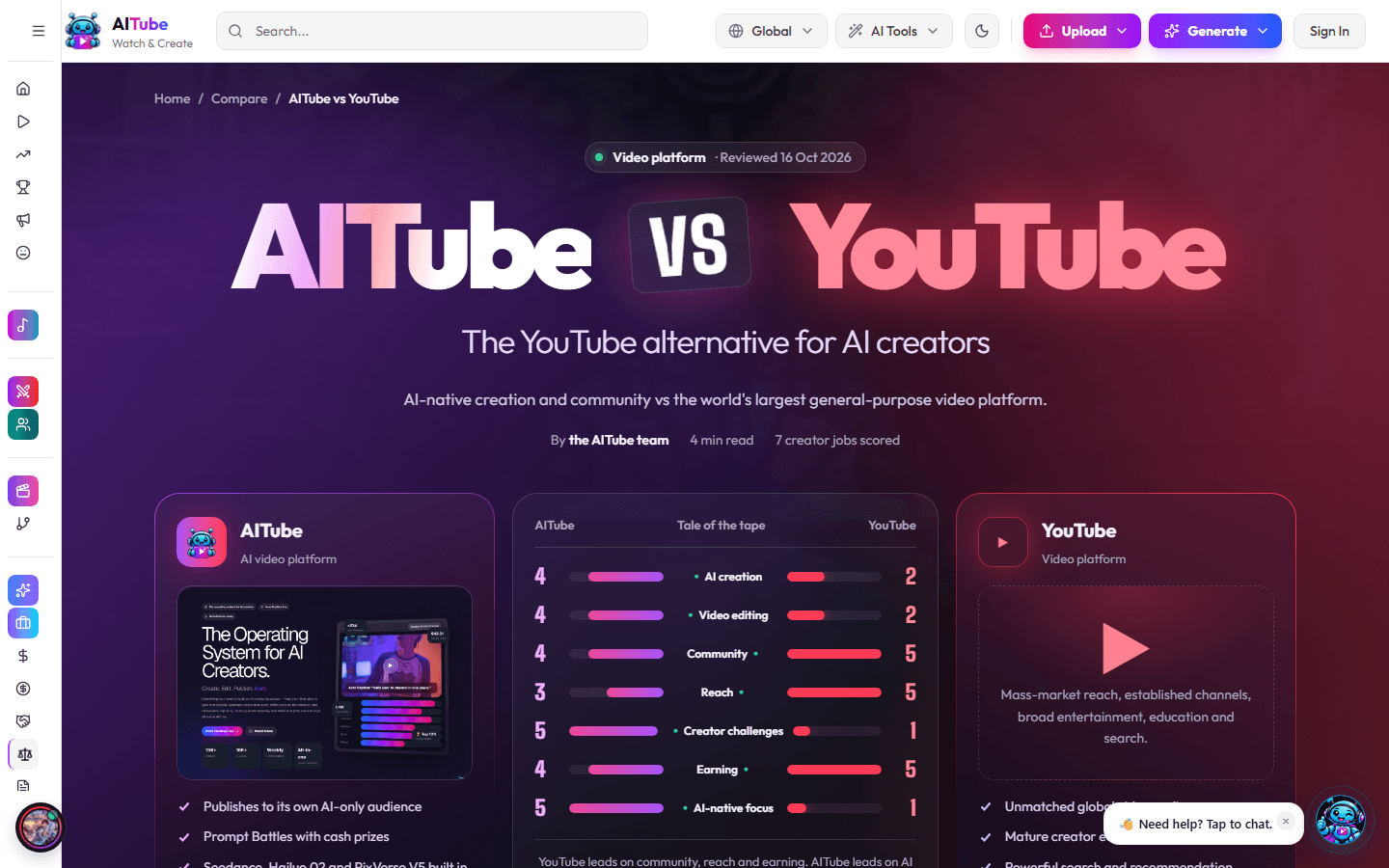
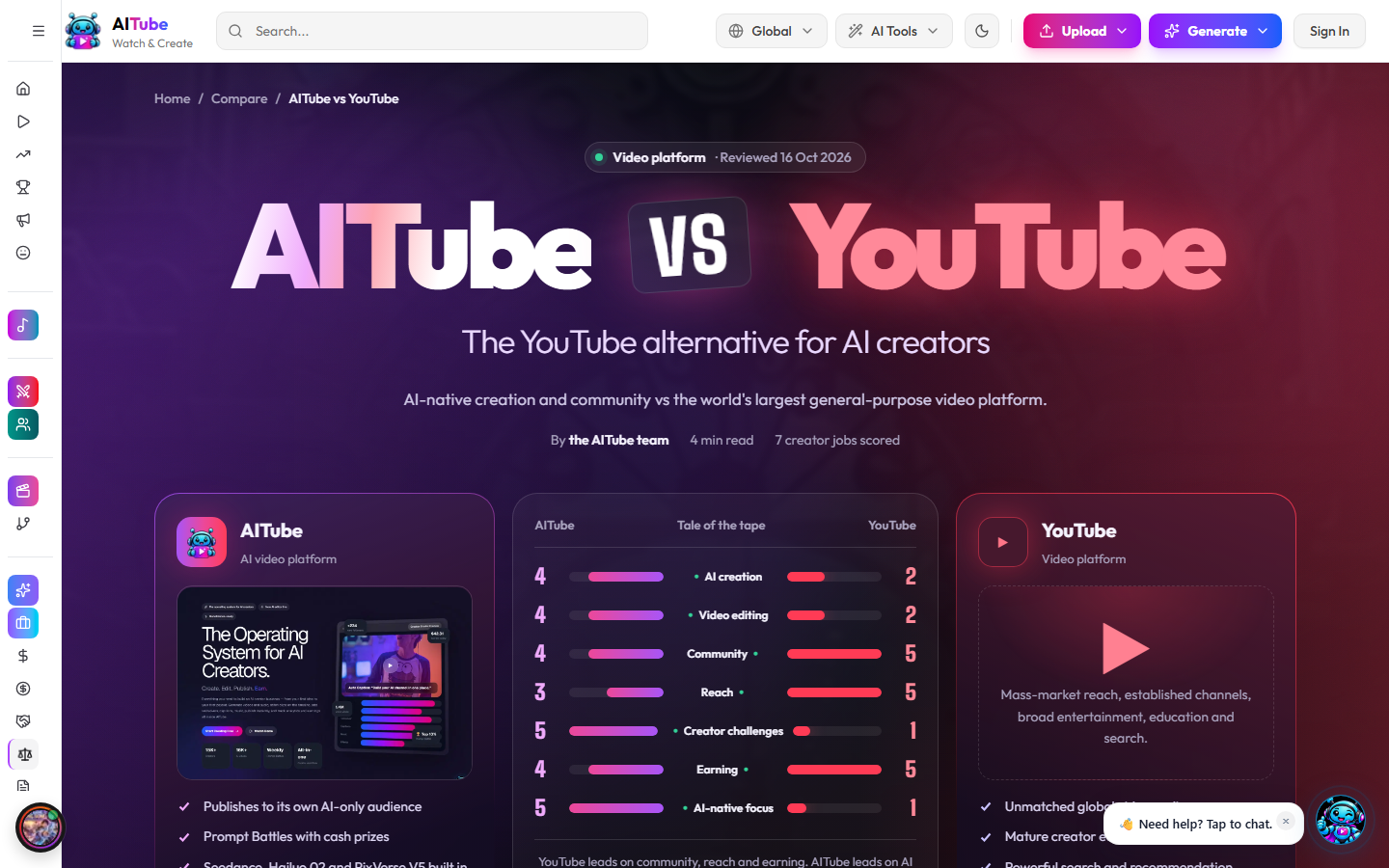
On our AITube vs YouTube comparison page, we score both platforms from 1 to 5 on seven creator jobs. We use the same method for every tool we compare, and we say plainly where the other product wins.
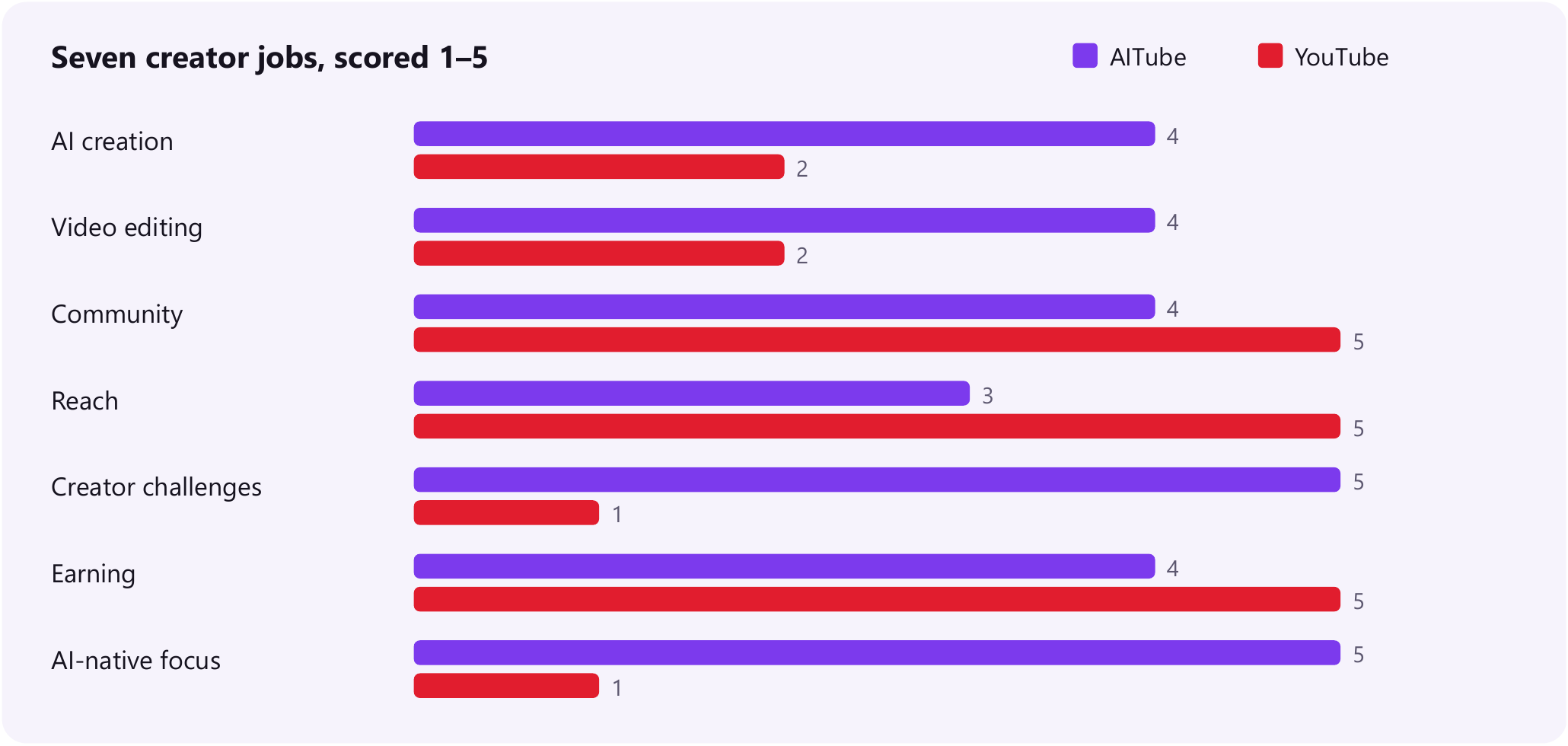
Put simply, YouTube wins the distribution jobs and AITube wins the AI-specific ones. Which matters more depends on what kind of creator you are. Let's go through each area.
1. Making the video
YouTube is primarily a place to upload finished videos. It has added some AI creation features over time, including generative tools for Shorts, but these are separate experiences rather than a full production workflow. Most AI creators still generate their clips somewhere else, edit them in a third tool, and then upload.
AITube puts creation inside the platform. Its Creator Studio gives you access to around 25 built-in AI video models, including Seedance 2.0 and 2.5, Kling 3, Veo 3.1, Hailuo 2.3, Wan, PixVerse and Runway Gen-4.5. From there you cut clips together on a timeline, add captions, music and voiceover, and publish straight to your channel. Tools like StoryShort turn a single prompt into an original short, and the caption generator supports Roman Urdu, Hindi and Hinglish.
Verdict: if you already have a production pipeline you love, YouTube doesn't get in your way. If you'd rather go from prompt to published video in one tab, and try several models without juggling subscriptions, AITube is the more efficient workspace.
2. Reach and discovery
This is where YouTube is in a league of its own. It has a global audience in the billions, a recommendation engine that can take a video viral overnight, and a search bar people use like a second Google. No AI-only platform can match that today, and we won't pretend otherwise.
But reach isn't the same as the right reach. On YouTube, an AI video competes with every vlog, podcast clip and sports highlight on the platform. Some viewers actively scroll past anything that looks AI-made, and comment sections can turn into arguments about whether AI content "counts".
On AITube, every viewer chose to be there for AI video. The audience is smaller, but it's pre-qualified: people who enjoy AI films, AI music and AI animation, and who often make them too. Categories are built around AI genres (AI movies, AI trailers, AI anime, AI influencers, AI ads, AI music), so niche work has a natural home.
YouTube gives you the biggest room. AITube gives you a room where everyone came for exactly what you make.
3. Rules for AI content
YouTube does allow AI-generated video, and using AI doesn't disqualify a channel from monetization on its own. But there are rules worth knowing:
Disclosure. Creators must label realistic altered or synthetic content, meaning anything a viewer could mistake for real people, places or events. YouTube says the label doesn't by itself affect monetization.
"Inauthentic content". YouTube renamed its old "repetitious content" policy to "inauthentic content" and has since tightened enforcement against mass-produced, template-driven, low-effort videos. Reviewers look at the channel as a whole, and some creators report that original work was wrongly flagged.
None of this is a ban, and creators doing original, high-effort AI work can and do succeed on YouTube. But the platform's starting assumption is that AI content needs extra scrutiny. On AITube, AI is the starting assumption. You still need to follow the community guidelines, but you never have to justify the medium itself.
4. Community and challenges
YouTube's community tools are mature: comments, community posts, memberships, live chat and years of creator culture. It scores a 5 on community for good reason.
What YouTube doesn't have is anything like Prompt Battles. These are AITube's themed AI video contests: you get a brief and a countdown, the community votes, judges weigh in, and the top three win cash to their wallet and credits to their account. Most battles are free to enter. According to the public Battle Arena page (as of 9 Nov 2026), 48 battles have been decided from 2,872 entries, with $1,450 in cash and 24,160 credits paid to winners.
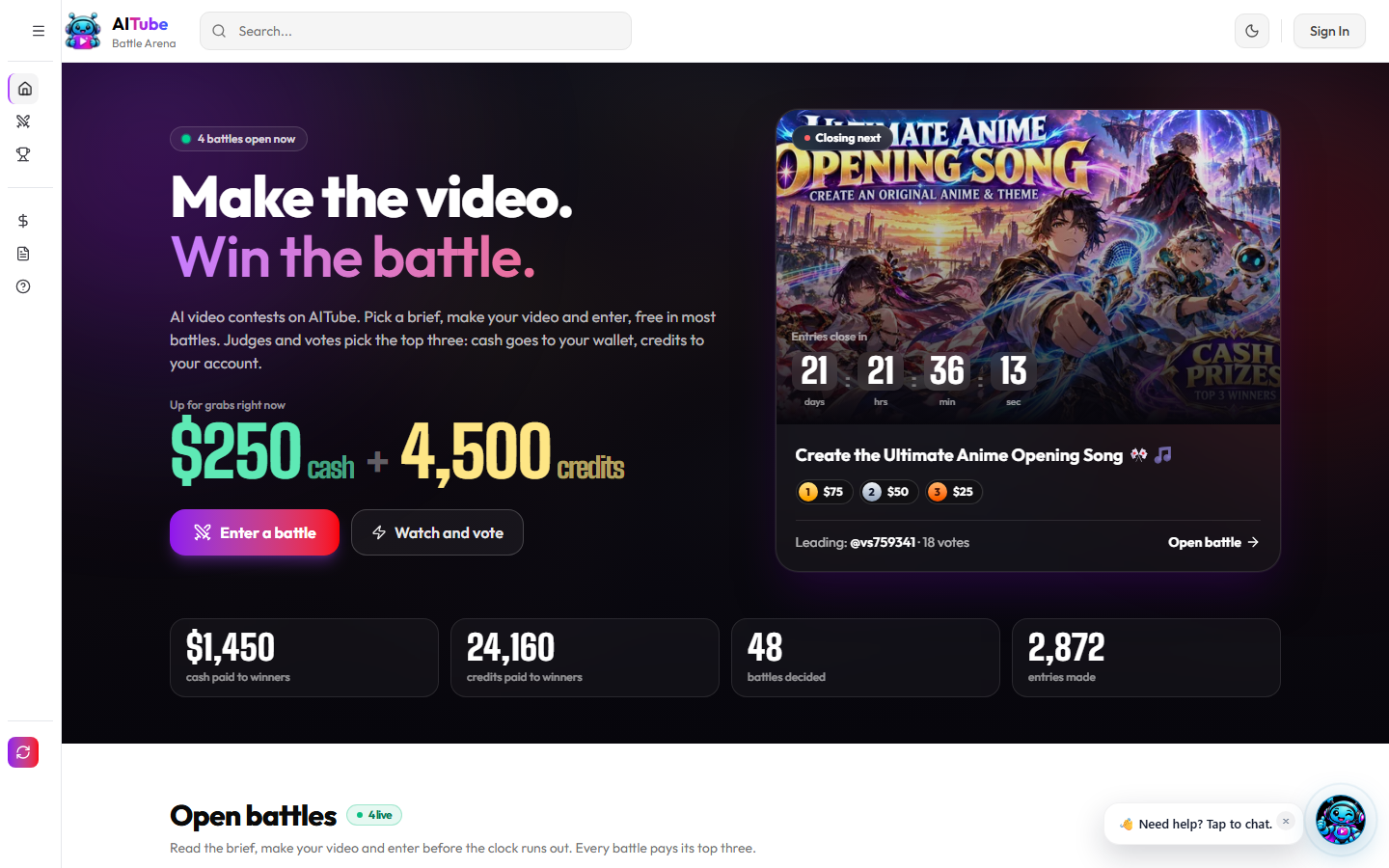
AITube's Battle Arena: a brief, a deadline and cash prizes for the top three. YouTube has no native equivalent.
For a new AI creator, battles solve the two hardest problems: knowing what to make next, and getting anyone to watch it. A brief removes the blank page, and voting guarantees eyeballs. Leaderboards and streaks give you a reason to keep going.
5. Earning money
YouTube has the most proven creator economy in the world. The YouTube Partner Program shares ad revenue once you qualify, which typically means 1,000 subscribers plus either 4,000 public watch hours in a year or 10 million Shorts views in 90 days. Memberships, Super Thanks and brand deals add more. For established channels, nothing beats it, and AITube's own scorecard gives YouTube the edge on earning.
The catch is the climb. Reaching those thresholds can take months or years, and AI channels face the extra content review described above.
AITube makes earning possible from day one: battle prizes paid in USD, a creator monetization program and an affiliate program, with cash-outs through Stripe or PayPal. The amounts are smaller than a big YouTube channel's, but there's no subscriber threshold between you and your first payout.
6. What it costs
Plan | AITube (checked 16 Oct 2026) |
|---|---|
Free | $0: account, watching, publishing and the community |
Pay as you go | $3 for 150 credits that never expire (1 credit = $0.02) |
Creator | $19.99/month: 1,050 credits a month that roll over |
Pro | $34.99/month: 2,200 credits a month that roll over |
Publishing on both platforms is free. On AITube, credits pay only for AI generation inside the studio. On YouTube, generation happens in whatever outside tools you already pay for. Check YouTube's own pages for any paid features, since prices change often.
Feature comparison
Capability | AITube | YouTube |
|---|---|---|
AI video generation | Built into Creator Studio, multi-model | Limited, separate AI experiences |
Timeline editing | Yes | Basic creator editing tools |
AI-only audience | Yes | No, general audience |
Global reach and search | Smaller, growing | Unmatched |
Creator challenges | Prompt Battles with cash prizes | No native equivalent |
Monetization | From day one: prizes, payouts, affiliates | Mature Partner Program, after thresholds |
AI content rules | AI is the default | Disclosure and "inauthentic content" review |
Which should you choose?
Choose AITube if…
AI video is your main creative medium
You want to generate, edit and publish in one place
You're starting out and need an audience now
You like contests, leaderboards and prizes
You want to earn before hitting big thresholds
Choose YouTube if…
Maximum reach is your top priority
Your content is search-driven, like tutorials and education
You already have an established channel
You mix AI with live-action or talking-head content
Ad revenue at scale is the goal
The smart move: use both
You don't have to choose. The workflow we see working best:

Create on AITube, trying several models on the same idea to find the best look.
Test on AITube's AI-only feed or in a Prompt Battle, where the feedback comes from people who understand AI video.
Pick the winners based on votes, views and comments.
Scale by posting your strongest pieces to YouTube, with proper AI disclosure where it's required, and link back to your AITube profile so new fans can find the rest of your work.
That way you get YouTube's reach for your best work, and an AI-native home, community and income stream for everything you make.
Final verdict
YouTube remains the biggest stage in online video, and for reach, search and mature monetization it's the clear winner. But it's a general-purpose platform, and AI creators work there under extra rules and extra skepticism. AITube is built the other way round: AI video is the point, creation tools are built in, every viewer came for AI work, and you can earn from your first battle.
If AI video is a side experiment, YouTube alone is fine. If it's your craft, give it a home that was built for it, and let YouTube be where your best work goes to meet the world. You can start free at aitube.app.