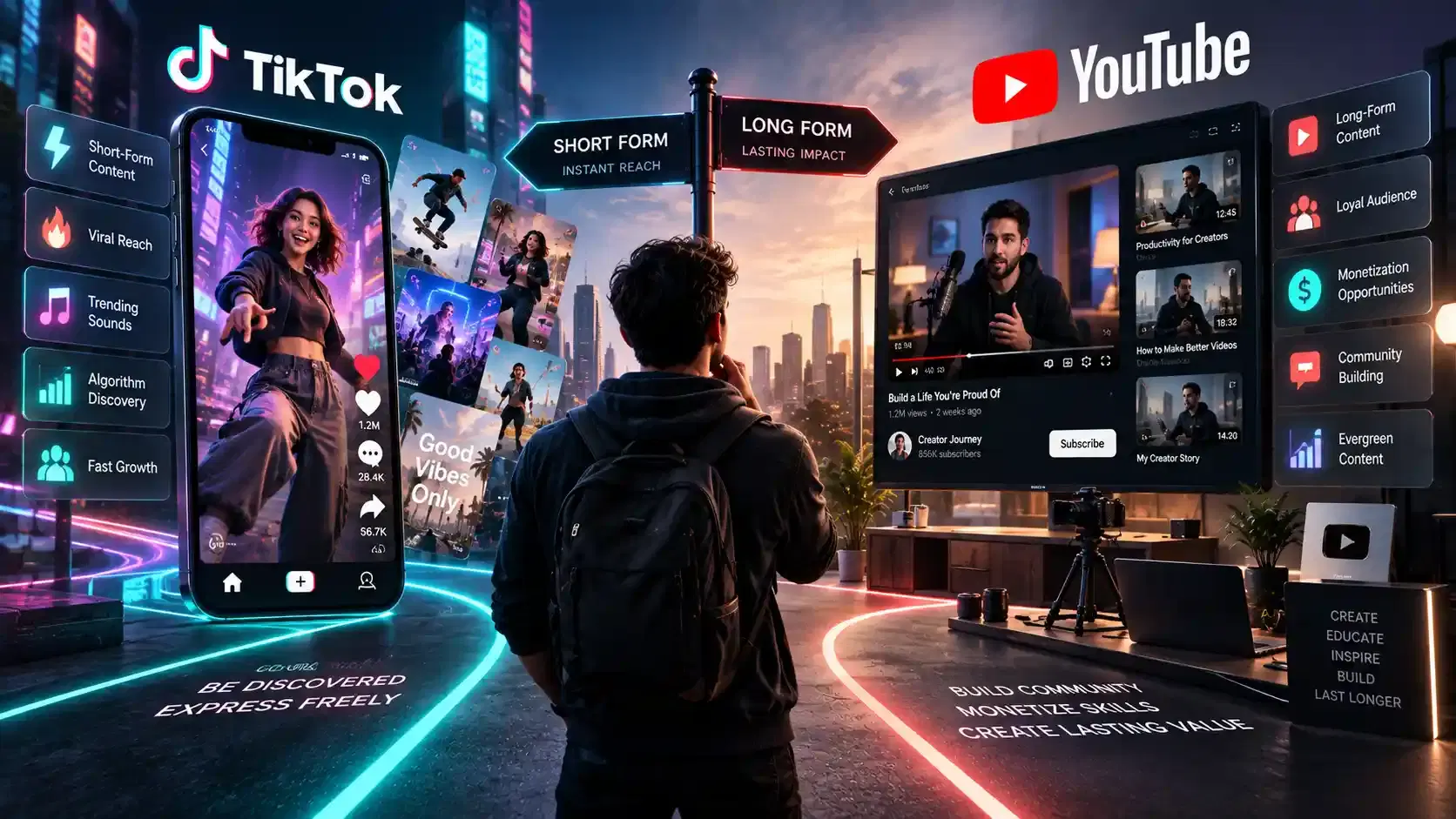
TL;DR: TikTok and YouTube are not really competing for the same job. TikTok is a discovery engine built for fast reach and cultural momentum. YouTube is a content library built for search, depth, and durable income. Pick TikTok when you need attention this week. Pick YouTube when you want views and revenue that keep compounding for years. Most serious creators run both, and the smartest ones make one video and ship it everywhere. This guide breaks down how the two platforms actually differ in 2026, and every major claim links to its primary source so you can verify it yourself. It also shows where an AI video tool like AITube fits into that workflow.
The "TikTok vs YouTube" debate usually goes wrong the moment someone tries to crown a single winner. They are different tools for different jobs. One is a slot machine of short clips tuned to keep you scrolling. The other is closer to a searchable video encyclopedia that happens to have a short-form feed bolted on.
So the useful question is not "which platform is better." It is "which platform is better for the specific outcome you are chasing." Reach today, or revenue that lasts? A quick viral hit, or an audience you actually own? Once you frame it that way, the answer gets a lot clearer.
Let's get into it.
TikTok vs YouTube at a glance
This is the full side-by-side, built entirely from 2026 data. Every number below is sourced later in the article.
Factor | TikTok | YouTube |
|---|---|---|
Global monthly users | ~1.9 billion | ~2.7 billion |
US adult usage (Pew 2025) | 37% | 84% |
Primary strength | Discovery and viral reach | Search, recommendations, and long-term watch time |
Discovery model | For You algorithm; follower count has less influence | Search, recommendations, subscriptions, and suggested videos |
Typical format | Short-form vertical video | Shorts, long-form, horizontal, and vertical video |
Maximum video length | Up to 10 minutes in-app; longer uploads may be supported depending on account/upload method | Shorts up to 3 minutes; long-form has no comparable short-form limit |
Content shelf life | Often days to weeks | Often months to years |
Best content types | Trends, entertainment, product discovery, short educational content | Tutorials, education, reviews, explainers, storytelling |
Creator monetization | Creator Rewards Program | YouTube Partner Program |
Creator payout model | Rewards based on qualified views and other eligibility factors | Multiple revenue streams, including ads, Premium, memberships, and more |
Ad cost per click | ~$0.50–$1.00 | ~$0.01–$0.03 |
Primary device | Mobile-first | Mobile, desktop, and connected TV |
Editing tools | Extensive in-app creation and editing tools | Basic native tools, with external software commonly used for advanced production |
Keep that table in mind. Almost every difference below is a downstream effect of the first few rows.
TikTok vs YouTube: The State of Play in 2026
Scale first, because it sets the context for everything else.
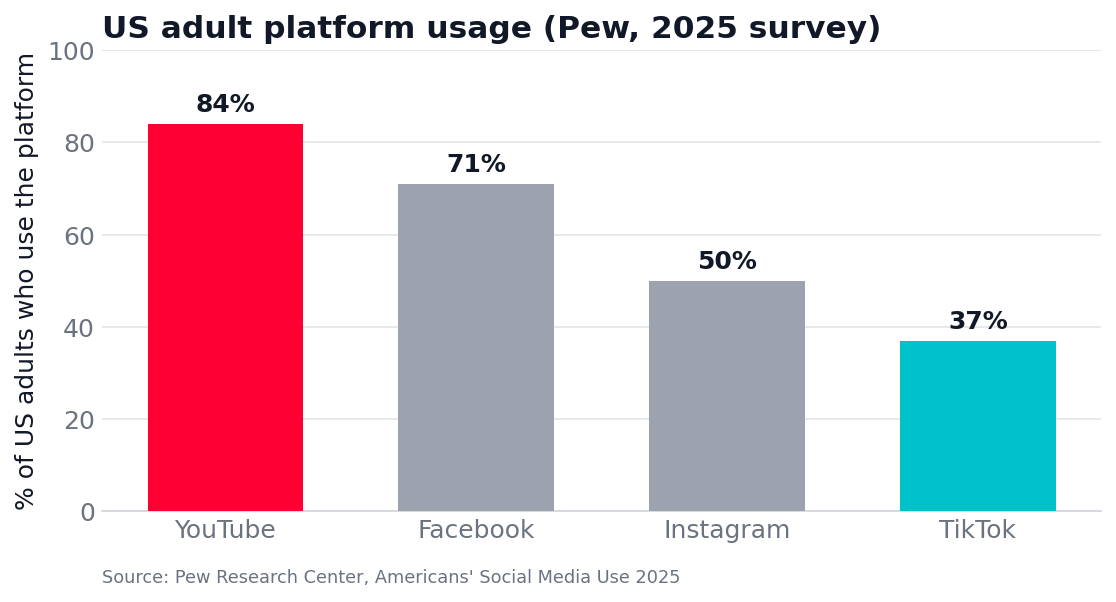
YouTube has about 2.7 billion monthly users around the world (Global Media Insight, 2026). Its short-form video platform, YouTube Shorts, now gets around 200 billion views each day. CEO Neal Mohan confirmed this number in his 2026 annual letter. In the United States, YouTube is the most widely used online platform tracked by Pew Research Center. About 84% of US adults use YouTube, compared with 37% who use TikTok.
TikTok sits at close to 1.9 billion monthly active users globally (ShortsIntel, 2026), with more than 170 million of them in the United States (Reuters, Jan 2026). Smaller than YouTube on paper, but ferociously engaged, and still one of the most downloaded apps in the world.
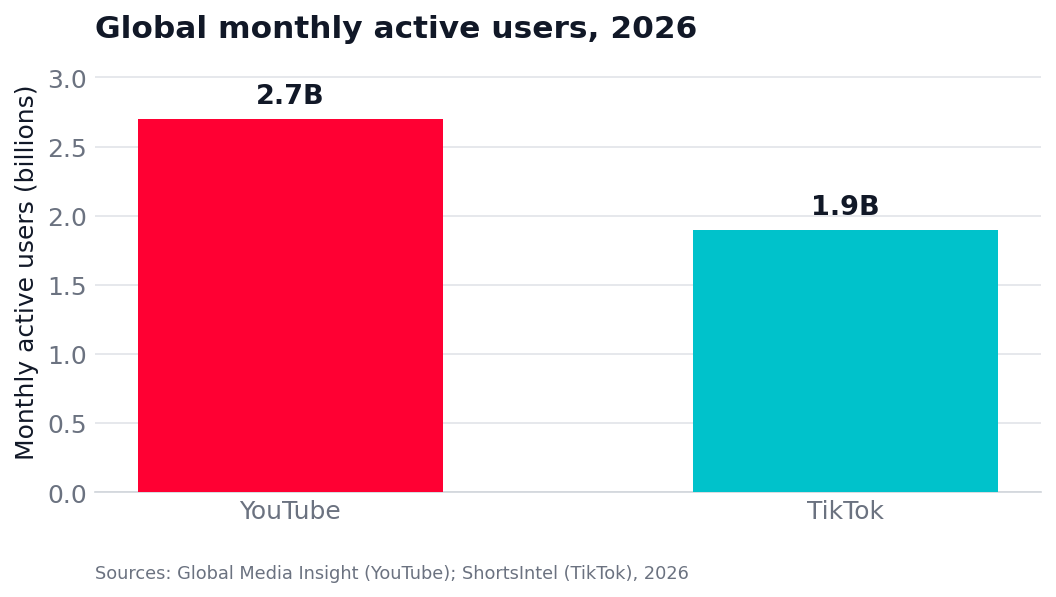
Note: TikTok does not publish an official global user figure, so its number is a third-party estimate (analyst estimates range from about 1.9 to 2.0 billion). YouTube's is also an estimate, though widely cited.
Here is the wider 2026 scoreboard, with each figure tied to its source.
Metric (2026) | TikTok | YouTube |
|---|---|---|
Global monthly active users | ~1.9 billion | ~2.7 billion |
US users / reach | 170M+ US users | Reaches 84% of US adults |
Short-form daily views | Not publicly disclosed | ~200 billion Shorts views/day |
US streaming watch-time rank | Not #1 | #1 for nearly 3 years (Nielsen) |
Maximum upload length | Up to 60 minutes | Effectively unlimited for long-form |
Ownership status | New US joint venture (2026) | Owned by Google since 2006 |
The other 2026 headline is the one every US and UK creator kept asking about: the TikTok ban saga finally has an answer. On January 22, 2026, ByteDance finalized a deal establishing a new majority American-owned entity, TikTok USDS Joint Venture LLC. ByteDance retained a 19.9% stake, with Oracle, Silver Lake, and MGX each holding 15%, in a deal valued at roughly $14 billion, as NPR reported. Oracle serves as the US security partner. The practical takeaway for creators: TikTok is not going dark in the US, but its ownership, algorithm oversight, and data governance now run through a restructured US entity. If you build your entire business on a single platform, that is a reminder of why platform risk is worth taking seriously.
TikTok vs YouTube: What's the difference?
Content length and format
TikTok built its reputation on clips of a few seconds, and short still wins on the For You feed. But the ceiling has moved a lot. In 2026 you can record up to 10 minutes in the app, and eligible accounts can upload pre-recorded files up to 60 minutes (Sociality.io, citing TikTok's Help Center). TikTok is quietly edging into YouTube's territory. Notably, its Creator Rewards Program only pays on videos longer than one minute, which tells you where TikTok wants creators to go.
Format option | TikTok | YouTube |
|---|---|---|
In-app recording | Up to 10 minutes | Shorts up to 3 minutes |
Uploaded file | Up to 60 minutes for eligible accounts | No practical limit for most creators |
Short-form feed | For You (core discovery feed) | Shorts |
Resolution ceiling | Supports high-resolution uploads; optimized primarily for mobile | Up to 4K and HDR supported |
Orientation | Primarily vertical | Vertical and horizontal |
Monetizable length | Creator Rewards requires eligible videos to be at least 1 minute long | Videos can generate revenue once the channel qualifies for the Partner Program; monetization depends on format and eligibility |
YouTube was always the home of long-form, and that has not changed. It also runs Shorts, which now allow vertical clips up to three minutes long after an October 2024 update. The real difference is range: YouTube comfortably hosts a 30-second Short and a 45-minute documentary on the same channel. It supports 4K and HDR, which makes it the default for polished, cinematic, or high-production work. TikTok stays deliberately raw, fast, and mobile-native.
Practical read: if your idea only works as a quick, punchy hook, TikTok is purpose-built for it. If your idea needs room to breathe, YouTube is the only one of the two that gives you the whole spectrum.
The algorithm and how people discover you
This is the deepest split between the platforms.
TikTok's For You algorithm optimizes for immediate satisfaction. It weighs watch time, completion rate, rewatches, shares, and comments, then serves a fresh, hyper-personalized stream. The upside is real: a brand-new account with zero followers can land a video in front of millions if the content performs. Discovery is fast and follower count barely matters.
YouTube's algorithm plays a longer game. It rewards average view duration, click-through rate on thumbnails, engagement, consistency, and search intent. It also highlights content in search results, on the homepage, in "Up Next," and in subscriptions. Traction takes longer to build, but a video that lands can keep pulling views for years. YouTube is often called one of the biggest search sites online. Its videos can show up in Google Search, so great content continues to gain views instead of fading away.
The mental model that helps: TikTok discovery is a wave you catch. YouTube discovery is a well you dig.
Audience and demographics
TikTok skews younger and trend-driven, but the "it's just teenagers" cliche is out of date. Its largest single age band is 25 to 34 (Exploding Topics), and its user base has broadened well beyond Gen Z. It remains the strongest place to reach young, culturally plugged-in audiences quickly.
YouTube casts the widest possible net. Its audience runs from toddlers watching cartoons to retirees watching news, with a huge and growing share of viewing happening on connected TVs in the living room. YouTube has been the number one platform in US streaming watch time for nearly three years, according to Nielsen data cited in Mohan's 2026 letter. If your content benefits from being watched on a big screen, that alone can decide the platform for you.
The reach gap is clearest in the United States. Pew Research Center's 2025 survey, the most recent edition available, found YouTube is used by more US adults than any other platform, well ahead of TikTok.
TikTok vs YouTube Monetization
For creators, this is usually the section that matters most, and it is also where a lot of older "TikTok vs YouTube" articles are simply wrong. Here is the verified 2026 picture.
YouTube pays creators through the YouTube Partner Program. According to YouTube’s own terms, creators keep 55% of long-form ad revenue and 45% of the ad revenue from Shorts (YouTube Official Blog). Creators can also make money through channel memberships, Super Chat, Super Thanks, merchandise, YouTube Premium revenue, and YouTube Shopping.
To get full ad monetization, you currently need 1,000 subscribers and either 4,000 watch hours in one year or 10 million Shorts views in 90 days. There is also a lower tier for creators with 500 subscribers, which gives access to some fan-funding features first (YouTube Help). One important change is coming on February 1, 2027. YouTube plans to raise the entry requirements for new applicants to 8,000 watch hours or 20 million Shorts views (Tubefilter). This means it will become harder for new creators to qualify.
TikTok retired its old, widely criticized Creator Fund and replaced it with the Creator Rewards Program. The old fund paid roughly two to five cents per 1,000 views. The new program pays meaningfully more, typically somewhere around $0.40 to $1.20 per 1,000 qualified views depending on niche and audience country, with US and UK views paying at the higher end (Toptal, 2026). To qualify you need 10,000 followers, 100,000 views in the last 30 days, an account in good standing, and videos that are at least one minute long. TikTok rounds this out with TikTok Shop, affiliate links, LIVE gifts, and brand partnerships.
Here is the same picture in one view.
Monetization factor | TikTok | YouTube |
|---|---|---|
Main program | Creator Rewards Program | YouTube Partner Program |
Entry bar | 10,000 followers, 100,000 video views in the last 30 days, age 18+ | 1,000 subscribers + 4,000 qualified watch hours in 12 months or 10M qualified Shorts views in 90 days |
Lower monetization tier | — | 500 subscribers + 3 public uploads in 90 days + 3,000 qualified watch hours or 3M Shorts views; enables fan-funding and Shopping features |
Core pay model | Rewards based on qualified video views and other factors | Long-form Watch Page ads, Shorts Feed revenue sharing, YouTube Premium and other monetization features |
Typical rate | ~$0.40–$1.20 per 1,000 qualified views* | Varies widely by niche, audience, geography, format, and advertiser demand |
Length requirement | Creator Rewards videos must be at least 1 minute long | No single minimum length for monetization; eligibility depends on the monetization feature |
Other revenue streams | TikTok Shop, affiliate commissions, LIVE gifts, brand deals | Memberships, Super Chat, Super Thanks, Shopping, YouTube Premium, merch and brand deals |
Revenue durability | Often more dependent on ongoing recommendation/viral distribution | Stronger long-tail potential through Search, recommendations, and the existing video library |
2027 change | No comparable announced change | From Feb. 1, 2027, new creators seeking ad/Premium revenue will need 1,000 subscribers + 8,000 qualified watch hours or 20M qualified Shorts views |
The honest summary is this: YouTube has more ways to make money, and its income can last longer. That is why many creators, including people in communities like r/NewTubers, say YouTube is a better choice if your goal is to make a living from content. TikTok has improved a lot and is getting closer, but there is still a key difference. A viral YouTube video can keep making money for years, while a viral TikTok video often gives you more reach and attention. Both platforms are valuable, but they offer different kinds of value.
TikTok vs YouTube Advertising
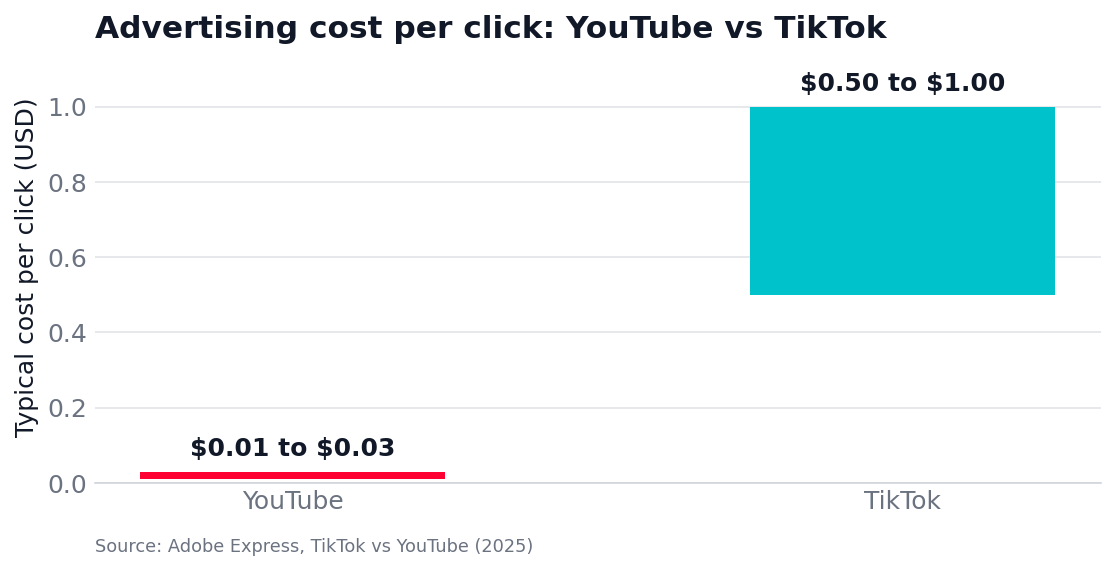
The platforms invert on advertising economics. Based on Adobe's 2025 breakdown, YouTube clicks tend to run cheaper on a cost-per-click basis (roughly $0.01 to $0.03) while offering advanced targeting by search history, intent, and demographics, which makes it strong for lead generation and remarketing. TikTok clicks cost more (roughly $0.50 to $1.00) but excel at native, scroll-stopping reach through in-feed ads, Spark Ads that boost existing organic posts, branded effects, and hashtag challenges. TikTok is your product-discovery and awareness engine. YouTube is your consideration and conversion engine.
Advertising factor | TikTok | YouTube |
|---|---|---|
Typical CPC | Varies substantially by market, objective, audience, and campaign setup | Varies substantially by campaign type, targeting, keyword intent, audience, and market |
Targeting depth | Demographics, interests, behaviors, location, device, custom audiences, and lookalikes | Demographics, interests, custom segments, first-party data, remarketing, and Google's broader audience/intent signals |
Signature ad types | In-Feed Ads, Spark Ads, Search Ads, branded effects, and other TikTok formats | Skippable in-stream, non-skippable in-stream, bumper, in-feed, Shorts, and Shopping formats |
Best suited for | Awareness, discovery, demand creation, product discovery, and social commerce | Awareness, consideration, conversion, remarketing, and intent-driven campaigns |
Retargeting | Strong: Pixel/site visitors, customer lists, content/ad interactions, and custom audiences | Strong: remarketing, first-party audiences, customer lists, and Google audience signals |
Creative advantage | Native, creator-style, fast-moving vertical creative | Broad format range across Shorts, long-form, Search, desktop, mobile, and connected TV |
Creation and editing tools
TikTok is built to remove friction. Auto-captions, a huge trending-sound library, in-app effects, filters, transitions, and AI-assisted editing suggestions all live inside the app, so a creator with a phone and an idea can publish in minutes. That low barrier to entry is a big reason new creators start there.
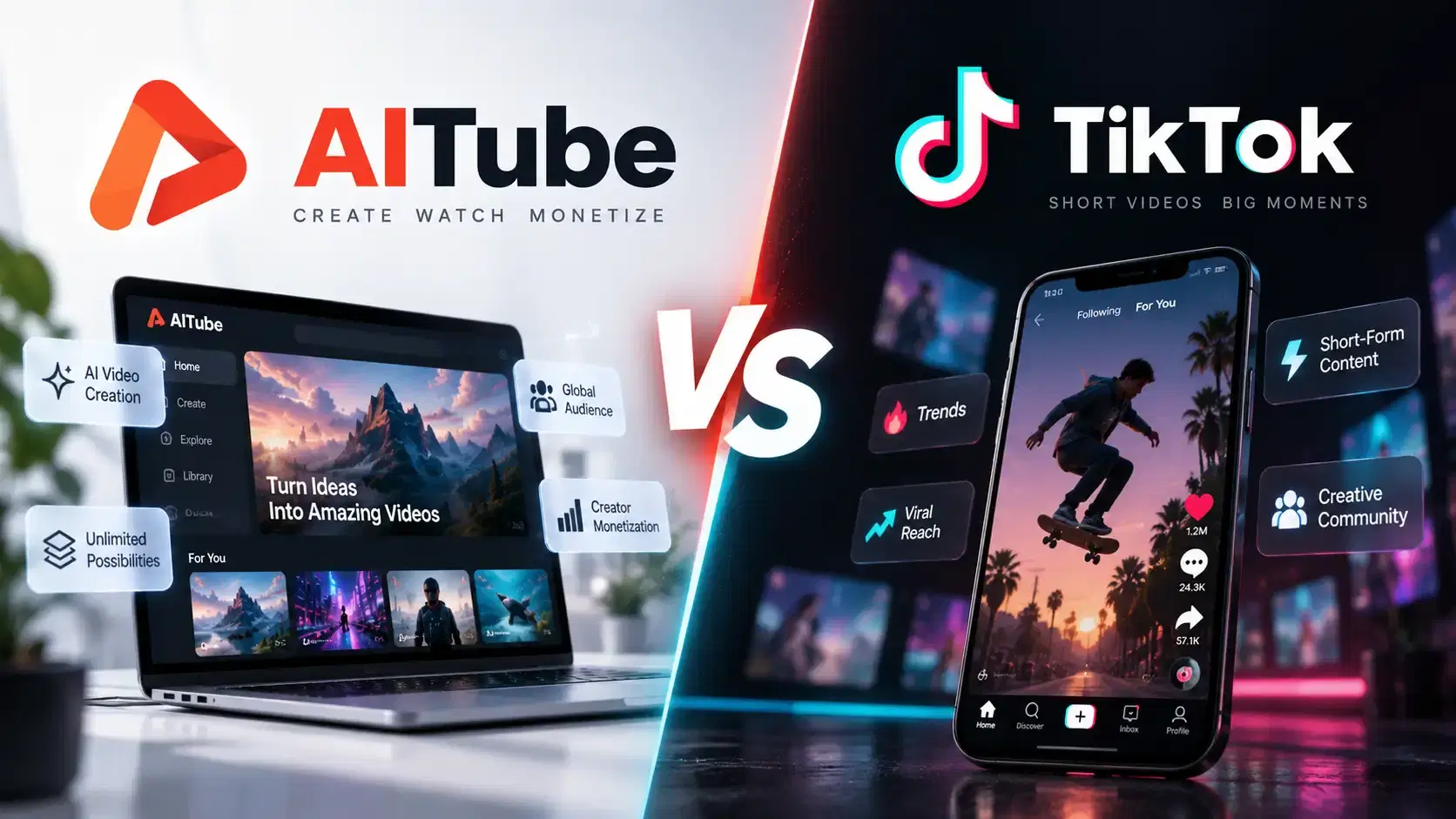
YouTube expects a higher production bar for long-form, and most established creators reach for external software to hit it. That gap between "easy to start" and "good enough to keep watching" is precisely the gap AI video tools now fill. Platforms like AITube let you turn a script, a prompt, or an idea into a finished video without traditional editing skills, then publish across categories from short films to explainers to ads. The point is not to replace either platform. It is to lower the production cost of feeding both of them consistently, which is the single hardest part of a two-platform strategy.
Content lifespan and SEO
A TikTok's useful life is often measured in days. A YouTube video's life is measured in months or years, because it keeps surfacing in search and recommendations long after you hit publish. If you are optimizing titles, descriptions, and thumbnails for discovery, YouTube gives that work compounding returns that TikTok's fast-moving feed simply does not. This is the core reason educational, tutorial, and evergreen creators lean YouTube.
Livestreaming
Both platforms support live streaming. TikTok LIVE focuses on gifts, co-hosting, and live shopping, making it a good fit for quick buying decisions. YouTube Live is better suited for higher-quality streams and offers features like Super Chat, premieres, and Q&A. It also benefits from being easy to watch on a TV. Choose the platform and format based on how your audience likes to watch content and how they make buying decisions.
Accessibility and cross-device reach
TikTok is mobile-first by design. YouTube is a genuine multi-device hub: web, mobile, tablet, smart TV, and console, with strong captioning, multi-language support, and subtitle customization. If reaching viewers on the biggest screen in the house matters to you, that is a YouTube advantage that is easy to overlook.
YouTube vs TikTok: Which Platform Is Better?
Stop thinking "better" and start thinking "which job." Match your goal to the platform built for it.
Here is the move most guides bury: you do not have to pick.
The efficient 2026 playbook is to make one strong vertical video, post it to TikTok for discovery, cross-post to YouTube Shorts for a second audience, and then expand your best-performing ideas into longer YouTube videos that carry SEO value and better monetization. TikTok becomes the top of your funnel. YouTube becomes the library that captures and keeps the audience TikTok sends you.
The reason more creators do not run both is simple: producing enough video for two platforms is exhausting. That is the bottleneck AI video generation is built to break. With a tool like AITube, you can generate videos from text, scripts, or ideas, adapt them for short-form and long-form, and keep a consistent publishing cadence across both platforms without a full editing suite or a production team. Feed the discovery engine and stock the library from the same source.
Want the most content for the least effort? That's AITube
TikTok and YouTube both expect one thing first: you have to make the video. AITube skips that step. If you want a platform that keeps production simple and still lets you earn from your videos, AITube is the one to start with.
Here's how it works. You type a prompt or a script, and AITube turns it into a finished video in seconds. It runs on top of the best AI models, like Google Veo 3, Kling, and Seedance. It picks the style, adds a voiceover, and handles the editing for you. One idea becomes a ready-to-post video. No camera. No crew. No editing app.
Make videos from text. Pick any style, from explainers and short films to ads and stories.
Post to your own channel. People find your videos through the feed, tags, and trending, just like on YouTube.
Join Prompt Battles. Enter themed contests to get seen and win badges and prizes.
Earn from your work. Make money through ads and the community, so your videos pay you back.
And it's not just for creators. Like YouTube, brands can run ads on AITube too. You reach people who came to watch AI videos on purpose. It's newer, less crowded, and cheaper than the big platforms, and that's usually where early advertisers get the most for their money.
Here's the part that ties it together. Make your video on AITube, post it there, then share the same video to TikTok and YouTube Shorts. One idea. Three platforms. A lot less work.
Honest trade-offs
No platform is free lunch. Plan against the real constraints.
TikTok's reach is rented, not owned. Follower counts translate weakly into durable audience or income, and platform, policy, or ownership changes can shift your reach overnight. The 2026 US restructuring is a live reminder.
TikTok monetization still rewards a narrow lane. Only videos over one minute qualify for Creator Rewards, and payouts depend heavily on audience geography.
YouTube is slow to reward you. Traction can take months, the production bar is higher, and the 2027 monetization threshold change makes the early climb harder.
YouTube Shorts pays less than long-form. The 45% Shorts split and pooled revenue model mean Shorts alone rarely build a full-time income.
Running both costs time. A two-platform strategy only works if you can produce consistently, which is exactly why creators lean on AI tooling and repurposing rather than doubling their workload.
None of these are dealbreakers. They are just the fine print. Budget for them and both platforms reward you.