Looking for a real YouTube alternative? Here is the short list by category
Category | Best Video Apps |
|---|---|
Best General Free Video Apps | Vimeo, Twitch, Dailymotion |
Best for Creator Freedom and Payouts | Rumble, Odysee |
Best Paid, Ad-Free Option | Nebula |
Best for AI-Generated Videos | AITube |
Each app on this list solves a different problem. Some fix the ad load. Some fix the algorithm. Some fix demonetization. AITube fixes something none other was built for: a real home for AI-generated video, with fair pay from day one. We will explain each pick below with its detailed pros and cons.
Key takeaways
People are not completely relying on YouTube anymore.
No single alternative fully replaces YouTube. Each one solves a different problem.
Rumble removes YouTube's waiting period, letting creators earn from their very first upload.
Odysee and PeerTube trade audience size for control, appealing to creators worried about takedowns.
Nebula charges viewers directly, which funds an ad free experience and a payout split.
Vimeo and Dailymotion work best as a second home, not a full replacement for YouTube's reach.
AITube is an AI-first video platform built exclusively for hosting, generating, and streaming artificial intelligence content.
Why Millions of Users and Creators Are Leaving YouTube
YouTube remains the largest video app on the internet. However, user frustration on YouTube is at an all-time high.
1. Aggressive Ad Load
Viewers face aggressive ad loads that ruin long watch sessions. YouTube now runs pre-roll, mid-roll, and overlay ads on most videos, and the load has grown heavier every year.
2. Algorithm Shifts and Shorts Priority
At the same time, many creators feel that algorithm shifts push “Shorts” over deep long-form videos, even when their audience prefers longer content. Viewers notice this too, since their feed can feel like an endless Shorts loop instead of the channels they actually follow.
3. Strikes, Demonetization, and Income Instability
Strikes and demonetization add another layer of stress. Confusing copyright strikes and sudden channel demonetization threaten creator livelihoods since a single flagged video can freeze income for weeks. The appeal process rarely feels fast or clear.
4. Rise of Mass-Produced AI Content
Above all, the rapid rise of AI based content, has made things worse by the fact that YouTube's own rules for real AI creators that can feel unclear or slow to catch up. Knowing why creators are looking at other platforms helps both viewers and channels pick better homes.
Top YouTube Alternative Apps Broken Down by Category
Finding a youtube alternative app depends entirely on what you want from your video player. Here is how the top contenders stack up across different use cases.
General-Purpose Video Platforms
These platforms come closest to replacing YouTube's basic function: upload a video, let people watch it, build an audience over time.
1. Vimeo
Vimeo focuses on clean, high-quality, professional video hosting rather than viral social feeds. This focus makes it an ideal free YouTube alternative app for filmmakers, agencies, and businesses who need high-definition embedded video players completely free of public ads or recommendations. Thus, unlike YouTube that operates as a public entertainment hub and discovery engine, Vimeo acts as a professional, software-as-a-service (SaaS) hosting suite.
Strength | Limit |
|---|---|
Creators can easily customize the visual presentation of their media, ensuring a clean portfolio appearance on corporate websites. The app is also completely ad-free, even on the free plan. | Its major drawback is its restrictive free tier. Vimeo enforces strict weekly upload quotas and low overall account storage limits, which can force growing creators and high-frequency uploaders to upgrade to paid plans quickly. |
2. Twitch
Twitch is Amazon’s live-streaming hub built around real-time entertainment, gaming, and interactive broadcasts. It thrives on raw, unedited community culture rather than polished, pre-recorded video uploads. As a YouTube alternative, Twitch utterly dominates live interaction through its active live chat and direct creator subscriptions. In a line, Twitch feels much more like a continuous digital hangout spot. .
Strength | Limit |
|---|---|
Twitch provides live broadcasters with immediate feedback loops and stronger community ties than traditional video sites. Real-time community tools like subscriptions, Bits, and live chat are more developed here than on YouTube Live. | Its biggest flaw is a weak internal discovery system for pre-recorded, long-form video content. Because the main homepage algorithm heavily favors creators who are currently live, offline channels and static uploads receive significantly less traffic compared with active streams. |
3. Dailymotion
Dailymotion is French-owned video sharing platform that feels like the closest general free alternative to YouTube's basic upload-and-watch model. It leans heavily into curated news, sports, music, and trending pop culture rather than creator-driven vlogs. As a YouTube alternative, it offers a familiar layout without YouTube’s hyper-aggressive algorithm tracking your every click. It has much laxer copyright algorithms, making it surprisingly popular for finding niche or regional content.
Strength | Limit |
|---|---|
Creators can easily publish content and start building an audience without navigating overly complex application processes. Uploads are free with no strict limits, and the platform includes a partner ad-revenue program similar in spirit to YouTube’s. | The disadvantage for viewers is its aggressive ad model. Free streams frequently run disruptive commercials, creating a cluttered viewing experience. For creators, its audience and discovery reach are much smaller than YouTube’s, so growth tends to be slower. |
Creator-Owned and Lower-Moderation Platforms
These platforms appeal to creators who want more control over their content, either through lighter moderation rules or a different ownership model.
4. Rumble
Rumble is a video-hosting platform designed explicitly around hands-off moderation and free speech ideals. Although it operates very similarly to YouTube's layout, it positions itself as an aggressive pushback against big-tech censorship. As an alternative to YouTube, Rumble appeals heavily to creators who fear getting demonetized, flagged, or banned by strict algorithms like political commentary and right-leaning voices.
Strength | Limit |
|---|---|
Rumble uses a direct ad-share model that does not require a huge subscriber count. Smaller channels can earn money from their very first upload without waiting months to qualify. | Its active user base leans heavily toward news, political commentary, and opinion content. Channels focused on general lifestyle, gaming, or niche hobbies may find it harder to build a broad audience here. |
5. Odysee
Odysee is an open-source, Web3 video platform built on decentralized, peer-to-peer network protocols. It sports a remarkably YouTube-like interface, but it stores data on a distributed system rather than mega-corporate data centers. Unlike Youtube, Odysee relies heavily on blockchain infrastructure to host videos, meaning creators truly own their content.
Strength | Limit |
|---|---|
Its decentralized system makes content moderation lighter and more transparent. Creators who have faced repeated demonetization or platform bans elsewhere gain a reliable backup for their work. | Payouts rely on a crypto-based token system rather than standard bank payouts. This setup creates a learning curve for creators who prefer traditional ad-revenue models. |
6. PeerTube
PeerTube is a free, open-source video network created by a French non-profit to give users complete control over their content. Like Odysee, its does not rely on one mega-corporate server hub like YouTube. Instead, it runs on thousands of independent, interconnected servers that seamlessly communicate with each other. Thus, it uses peer-to-peer (P2P) technology during playback, meaning viewers share bandwidth to keep small servers running smoothly with ultimate privacy, zero censorship risks, and true digital autonomy for privacy-focused communities.
Strength | Limit |
|---|---|
Creators gain greater digital independence from corporate control. There is no central algorithm hiding videos, no tracking scripts harvesting data, and no middleman taking a cut of your work. | The core network has no built-in monetization tools. Creators must manually integrate fan donations or set up custom payment links, which requires additional technical effort. |
Paid, Ad-Free Platforms
7. Nebula
Nebula is a paid, subscription-based streaming service built by and for high-profile online creators, thinkers, and educators. It functions much more like a curated platform for intellectual content than a chaotic, open-to-all video host. As a YouTube alternative, Nebula completely rejects algorithm-driven clickbait, comment section toxicity, and intrusive ad breaks. It also allows artists to split subscription revenues directly without fearing random demonetization..
Strength | Limit |
|---|---|
No ads and no algorithm chasing watch time. Viewers pay a flat fee, and creators are paid from that shared pool. | It is not an open upload platform. You cannot simply start a channel from scratch here as you can on YouTube; instead, it works more like a curated lineup of existing creators. |
8. AITube: An App Built for AI Video from the Start
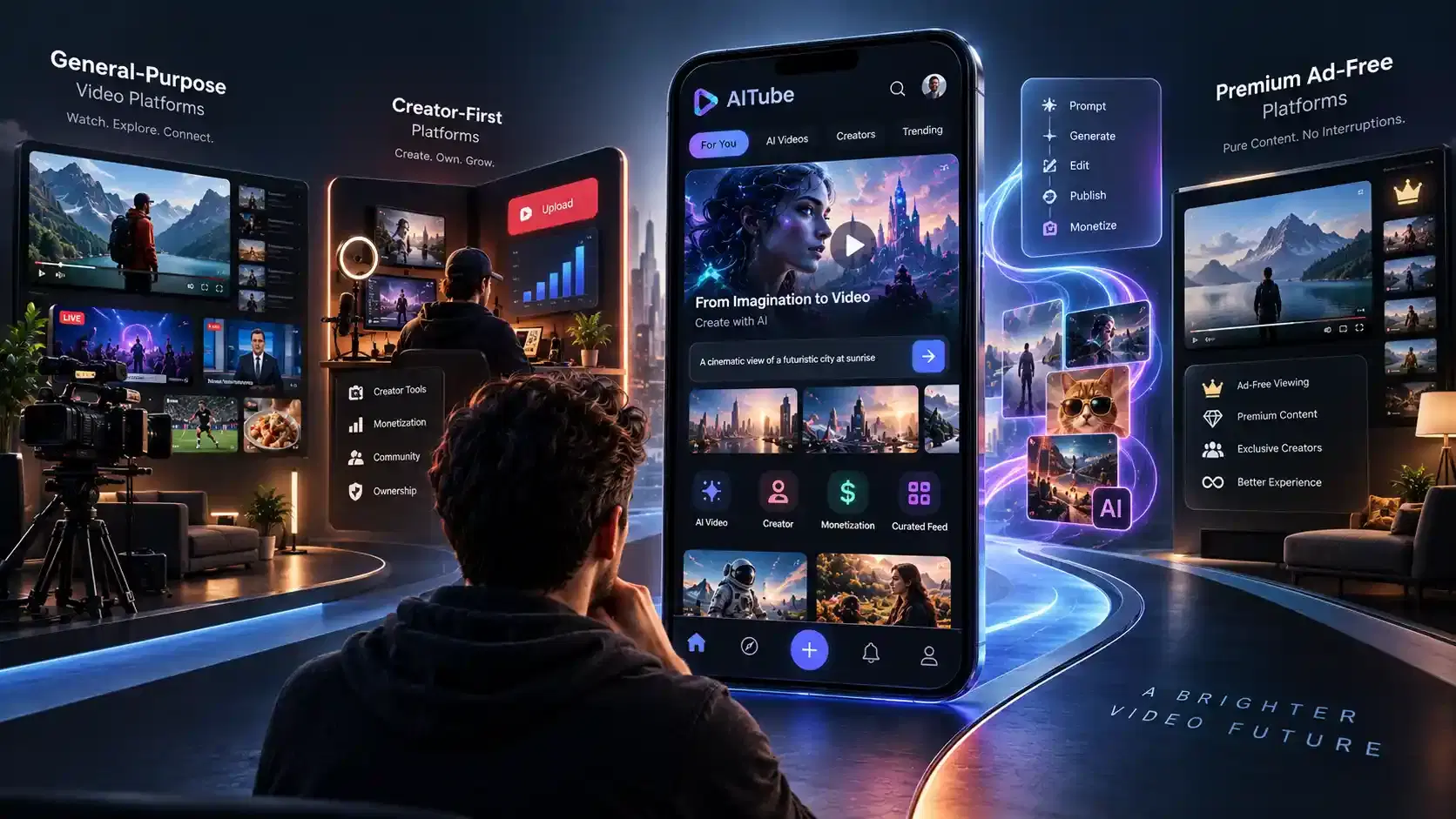
Every platform above was originally designed for traditional, human filmed video, then had to bolt on rules for AI content after the fact. That is part of why YouTube's AI policies feel confusing to so many creators, they are patches on a system that was not built with AI in mind. AITube, on the other hand, is a platform that caters entirely to prompt-based creation. As a result, it lets users turn text directly into shareable clips without cameras, recording gear, or traditional editing tools.
A curated feed, not an open-upload flood.
Instead of an endless stream of low-effort, mass-produced clips, AITube's feed is built around quality AI work. That means viewers see content worth watching, and creators are not competing against a wall of copy-paste videos for attention.
No subscriber or watch-hour wall.
On YouTube, earning money means clearing a subscriber count and a watch-hour or view target first, sometimes for months. AITube does not gate monetization behind that wall. Creators can earn from AI-made video from day one instead of waiting to hit a big number.
No fighting platform rules built for someone else.
YouTube's rules on AI content keep shifting, and they were written for a platform where human-only video was the default for twenty years. Since AITube was built around AI video from the start, its rules fit AI creators instead of working against them. You can make AI video without fighting platform rules using AITube's Creator Studio.
Want to know exactly how the money works? Read how creators earn on AITube. And if you want to see what a feed built entirely for this kind of content actually looks like, check out a feed built entirely around AI video.
Platform | Best For | Ad-Free | Creator Payout | Standout Feature |
|---|---|---|---|---|
Vimeo | Professional video | Yes | Paid hosting plans, not ads | Clean, branded player |
Twitch | Live streaming | No | Subscriptions, Bits, ads | Real-time chat and community |
Dailymotion | General free hosting | No | Ad revenue share | Free, unlimited uploads |
Rumble | Creator freedom | No | Revenue share, low entry barrier | Fewer content restrictions |
Odysee | Decentralized ownership | No | Crypto-based rewards | Blockchain-based publishing |
PeerTube | Self-hosted independence | Yes | None built in | Fully federated, open source |
Nebula | Curated, ad-free viewing | Yes | Subscription pool | No algorithm, flat-fee model |
AITube | AI-generated video | Yes | Pays from day one | Built for AI video, curated feed |
Bottomline
In a nutshell, in 2026, Youtube is not the only platform viewers using for entertainment and information. Likewise, it is not the only platform where creators can create and get their content monetized. Instead, there are many other apps like Dailymotion, Odysee, Nebula, AI tube etc, specialized differently. Among them, AItube is one of the few forums that totally support AI content, allowing creators to produce, publicize, and monetize their synthetic content without chaos.