Introduction
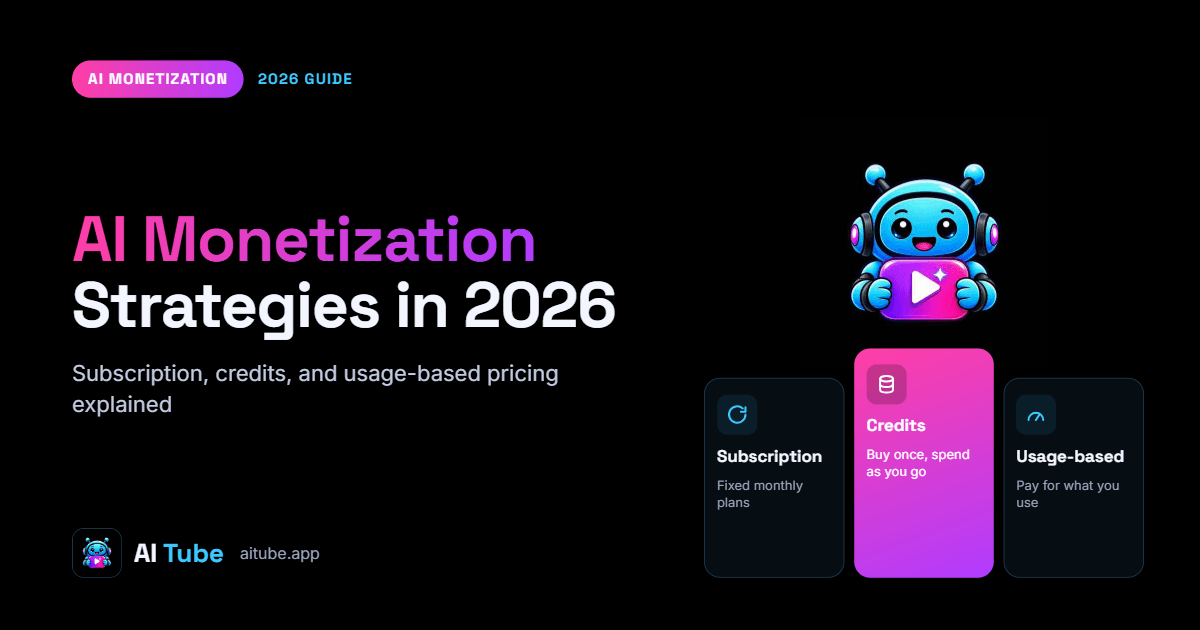
Artificial intelligence is creating new opportunities for software companies, developers, and digital platforms. Businesses can use AI to automate tasks, generate content, analyze information, and deliver personalized experiences. But building an AI product is not enough to create a sustainable business. Companies also need a monetization model that customers understand and that covers the cost of delivering the service.
AI monetization is the process of generating revenue from AI-powered products, services, features, or infrastructure. Depending on the product, a business may charge a subscription, sell usage credits, bill according to consumption, offer enterprise plans, or combine several approaches.
In 2026, pricing decisions are particularly important for generative AI tools because customer usage and operating costs can vary. A person generating a few images may use very different resources from a business producing hundreds of videos or making frequent API requests.
This guide explains common AI monetization strategies, how to select a pricing model, and how to make the model easier for customers to understand.
What Is AI Monetization?
AI monetization means turning the value of an AI capability into a revenue stream. The capability might be a writing assistant, image generator, video editor, customer-support agent, forecasting system, developer API, or enterprise automation tool.
The key is to charge for value customers actually receive. An AI product that saves a business several hours each week may justify a recurring fee. A service used for occasional image or video generation may be better suited to prepaid credits or a usage-based model.
AI companies should also distinguish revenue from profitability. A product may generate substantial sales but still struggle if model inference, infrastructure, support, payment fees, and customer acquisition costs exceed the revenue it earns.
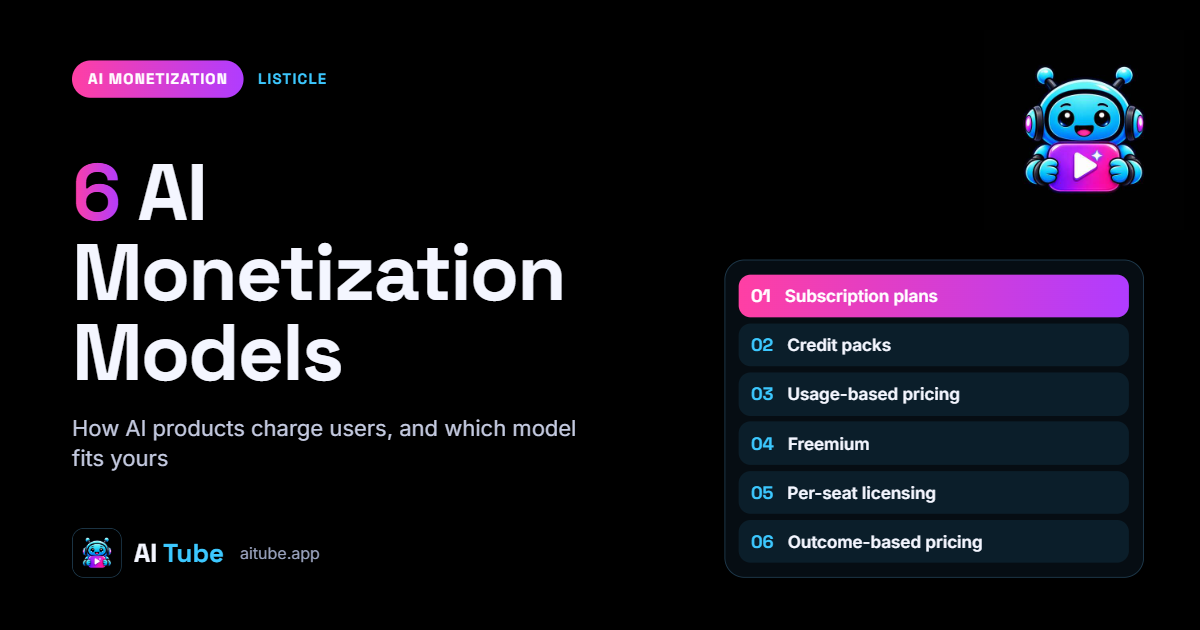
6 AI Monetization Models
1. Subscription pricing
Customers pay a recurring fee for access to a defined set of features. Subscription tiers may differ by usage limits, model access, processing speed, storage, collaboration, or support.
Advantages: predictable billing, easier budgeting, and recurring revenue.
Challenges: heavy users may cost more to serve than expected, while occasional users may cancel if they do not receive enough ongoing value.
Subscriptions work best when the product delivers continuing value and the plan clearly explains what is included.
2. Usage-based pricing
Usage-based pricing charges customers according to how much of a service they consume. Metrics might include API requests, generated media, processing time, tokens, or other measurable units.
Stripe’s guide to usage-based billing models explains how businesses can meter usage and charge according to consumption.
Advantages: customers can start small and pay in proportion to use; businesses can align revenue with consumption.
Challenges: revenue may fluctuate, bills can be harder to predict, and users may hesitate if they do not understand the cost of each action.
This model requires accurate measurement, clear unit pricing, usage visibility, and sensible spending controls.
3. Prepaid credits
A credit system lets customers purchase a balance and use it for eligible actions. For example, a creative platform might charge different credit amounts for different types of media generation or processing tasks.
Credits can make variable usage easier to manage because customers choose how much to purchase in advance. However, businesses must explain how credits are consumed, whether they expire, what actions cost, and whether unused balances are refundable.
A credit system should not hide the real price. Customers need a straightforward way to estimate the cost before starting a task.
4. Freemium pricing
A freemium model offers basic access at no cost and charges for additional value. The free tier may help users explore the product, understand its usefulness, and build a habit before upgrading.
For AI products, free access may have defined limits on usage, features, or available capacity. Those limits should be visible and understandable.
A free plan is not automatically a successful customer-acquisition strategy. Companies should measure whether free users activate, return, upgrade, or generate costs that the business cannot sustain.
5. Enterprise licensing
Enterprise plans serve organizations that need additional controls, administration, integration, security, support, or contractual arrangements.
Pricing may depend on seats, usage, deployment requirements, service levels, or a negotiated package. Enterprise customers often evaluate reliability, privacy, access controls, data handling, and support alongside functionality.
The sales process may be longer than for individual users, but enterprise pricing can be appropriate when the product solves a high-value business problem.
6. Hybrid pricing
A hybrid model combines recurring access with a variable component. For example, customers might pay a monthly fee that includes a set amount of usage and then purchase additional credits or pay for overages.
This approach can balance predictable revenue with the ability to charge for additional consumption. The challenge is keeping the pricing understandable. Avoid a structure so complicated that customers cannot estimate their bills.
How to Choose an AI Monetization Strategy
Understand the value metric
The value metric is the unit that connects price to customer benefit. It might be a user seat, generated video, processed minute, API request, completed workflow, or monthly usage allowance.
Choose a metric that customers can understand and that reasonably reflects the value delivered. Charging for an internal technical measurement may make sense for developers, but a creative user may prefer to understand the cost per finished output.
Calculate delivery costs
Estimate the costs associated with each major action, including AI inference, storage, media processing, infrastructure, payment fees, support, and other relevant expenses.
Costs may differ by model, output length, resolution, or task complexity. Use actual usage data wherever possible and allow for variation rather than assuming every request costs the same.
Match pricing to customer behavior
If most customers use a product regularly, a subscription may fit. If their usage changes significantly from month to month, credits or usage-based billing may be more suitable. If both patterns exist, consider a hybrid model.
Make costs predictable
Customers should be able to see how much they have used, how much balance remains, and what happens when they reach a limit.
Useful safeguards include:
Usage dashboards and billing summaries.
Notifications when usage reaches a chosen threshold.
Optional spending caps.
Clear overage rates.
Prepaid credits or bundled allowances.
An explanation of what each plan includes.
These controls can improve trust and reduce unexpected charges.

AI Monetization for Generative AI Software
Generative AI products create text, images, audio, video, code, or other outputs. The resources needed to create those outputs can vary widely, so the pricing structure should reflect the product’s actual cost drivers.
A text tool may price by usage volume, while a video generation service may consider duration, output quality, or processing complexity. A developer platform may charge by API request or consumption units.
Avoid assuming that one pricing model fits every generative AI product. Test whether customers understand the price, whether the price reflects the value delivered, and whether the economics remain sustainable at different usage levels.
Choosing an AI Monetization Platform for Usage-Based Billing
An AI monetization platform or billing system can help track consumption, calculate charges, manage subscriptions, and provide billing records. Before choosing a solution, assess the following:
Metering accuracy: Can it record the units that your product actually uses?
Pricing flexibility: Can it support subscriptions, credits, tiers, and overages if needed?
Usage visibility: Can customers view current and past consumption?
Billing reliability: Can it reconcile usage records with invoices?
Integration requirements: Does it work with your existing application and payment setup?
Spending controls: Can you set limits or alerts?
Reporting: Can you analyze usage, revenue, and customer behavior?
Security and privacy: Does the solution meet your data-handling requirements?
Stripe provides guidance on usage-based SaaS pricing, including metering, billing, and ways to make customer costs more predictable. Compare any provider against your specific technical and business requirements instead of assuming one service is best for every company.
AI Monetization, Privacy, and Customer Trust
AI products may process prompts, uploaded files, generated outputs, or business data. Monetization should not come at the expense of transparent data practices.
Explain what information is collected, why it is needed, how long it is retained, and whether it is shared with third parties. Follow applicable privacy laws and make sure marketing promises match the product’s actual data-handling practices.
Avoid selling or repurposing personal data without an appropriate legal basis and clear disclosure. Businesses should also consider access controls, retention limits, security reviews, and the risks associated with sensitive information.
Trust is part of the product experience. Customers are more likely to continue paying when pricing, usage limits, and data practices are easy to understand.
How AITube Fits into the AI Creator Economy
AITube is an AI-powered video and creator platform built around creating, watching, and earning. Its AI Studio provides an entry point for exploring its available video creation and editing tools.
The broader lesson for AI creator platforms is that monetization needs to connect product value with the creator’s workflow. Useful tools can help creators produce content, but revenue opportunities also depend on audience development, platform rules, eligibility, and the quality of the content being published.
Creators should check AITube for current product details, pricing, and applicable terms before choosing a plan or assuming a particular earning opportunity is available.
How to Test and Improve Your AI Pricing
Start with a simple pricing hypothesis. Define your target customer, the problem you solve, the value metric, and the costs associated with serving a typical user.
Then measure:
Free-to-paid conversion rate.
Revenue per paying customer.
Usage per customer and its cost.
Retention and cancellation.
Gross margin by plan or usage segment.
Customer feedback about price clarity.
Frequency of unexpected usage or billing complaints.
Test changes carefully. If conversion increases after a price change but retention drops, the result may not be beneficial over the long term. Use cohorts and consistent measurement periods to understand the trade-offs.
Conclusion
Successful AI monetization starts with delivering real value and choosing a pricing model that customers understand. Subscriptions, credits, usage-based billing, freemium access, enterprise licensing, and hybrid pricing can all work in the right context.
In 2026, businesses should focus on transparent costs, reliable usage tracking, clear limits, privacy, and sustainable unit economics. Test the model with real customer behavior, communicate pricing honestly, and refine the approach as the product grows.