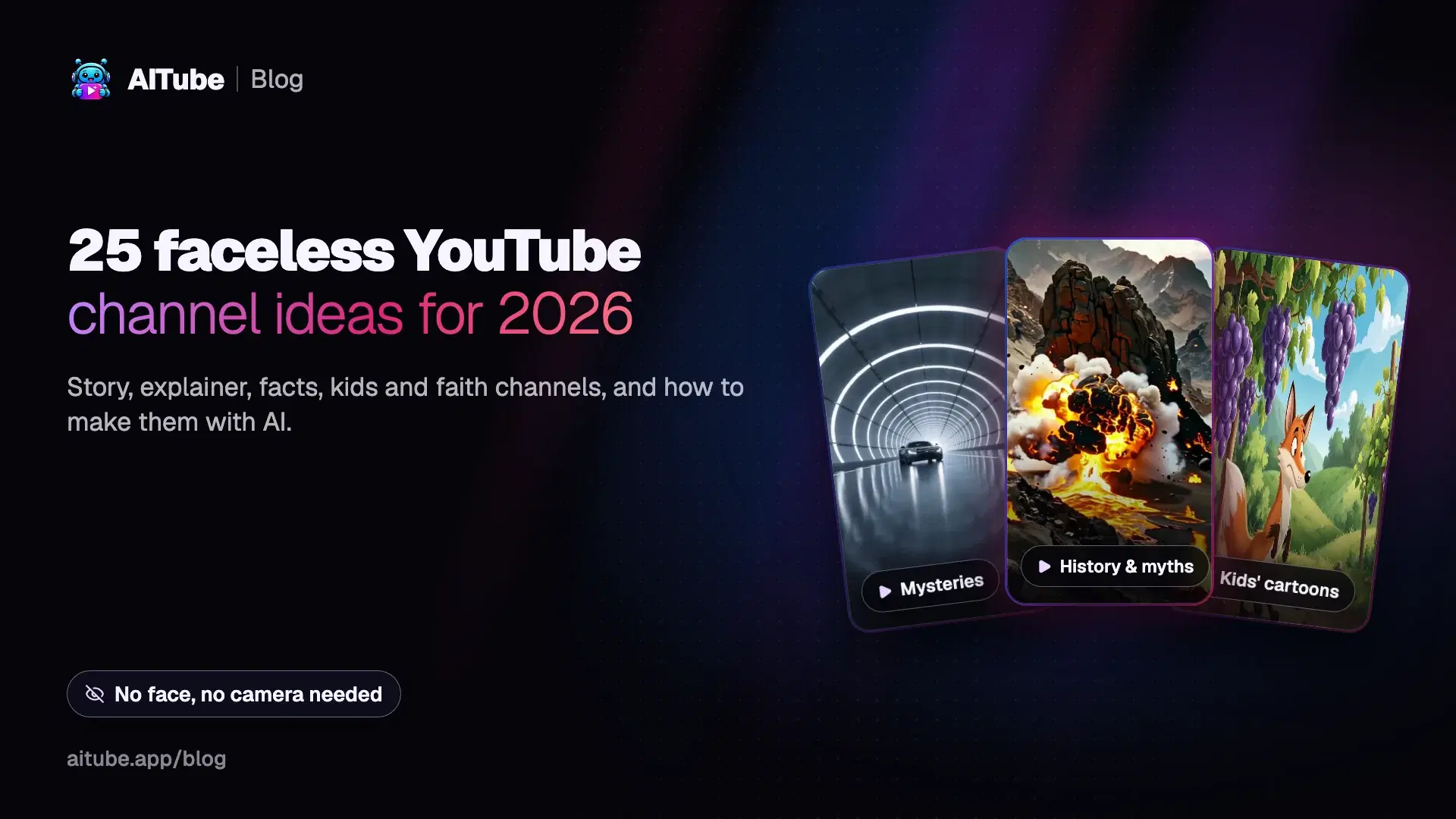
A faceless YouTube channel is one where you never appear on camera: a narrator, visuals and captions carry every video. In 2026 AI tools can make the voice, the visuals and the captions from one idea, so the hard part is no longer production but picking a niche you can sustain and making each video worth watching. Below are 25 faceless YouTube channel ideas that work, grouped by type, including the formats AITube creators make most, and how to turn any of them into finished videos.
Key takeaways
Pick a series, not a topic. "Lost cities, one per episode" beats "history videos": one idea becomes 50 videos.
Story channels and explainers are the easiest to start: a script, a narrator and visuals are all they need.
Originality decides the money. YouTube pays faceless and AI-made videos, but not mass-produced or templated ones.
Make the first 30 videos before judging a niche. Faceless channels grow from consistent series, rarely from one viral upload.
What makes a faceless channel work in 2026
Three things decide whether a faceless channel grows and earns. First, a repeatable series: viewers subscribe to a format they can expect more of. Second, real creative input: YouTube's monetization policies refuse generic, repetitive or mass-produced videos, so every episode needs its own script, angle and edit, even when AI does the production. Third, honest labeling: if a video looks realistic and was made or altered with AI, YouTube asks you to disclose it, and doing so doesn't cost you money.
The ideas below are chosen because they fit those rules: each one has endless episodes, needs a writer's angle, and works without a face.
25 faceless YouTube channel ideas
Story channels
Horror and mystery stories: short original scary stories with a narrator, dark visuals and sound effects. Example: "The house that kept the lights on."
Werewolf, vampire and fantasy romance serials: cliffhanger episodes of an ongoing love story; a favourite format of AITube's StoryShort creators.
Emotional life stories: short fictional stories about family, loss and second chances, told in first person.
Bedtime stories for kids: gentle, illustrated stories with a calm narrator and soft music.
Fables and folk tales retold: Aesop, Panchatantra or regional folk tales with a modern lesson at the end.
AI drama series: micro-dramas with recurring characters, one to three minutes an episode.
Explainers and documentaries
History mysteries: lost cities, unsolved disappearances, forgotten empires.
Space and science explainers: black holes, deep sea, how the body works, with clear visuals.
Mythology: Greek, Norse, Hindu or Egyptian myths, one god or story per episode.
"What if" scenarios: what if the Moon disappeared, what if you lived in 1500.
Geography and cultures: countries, strange borders, how people live in extreme places.
Facts and lists
Animal facts: one animal per Short, with surprising facts and close-up visuals.
Weird and surprising facts: fast-paced Shorts with a hook in the first second.
Rankings and comparisons: "the 10 deepest lakes", "the oldest cities still standing".
Money, work and self-improvement
Personal finance basics: budgeting, saving and how money works, explained simply. Keep it educational: YouTube won't monetize AI personas presented as financial advisers.
Side hustles and small business tips: practical ideas with examples, not income promises.
Productivity and study tips: routines, focus techniques and tools, as short how-tos.
Motivational stories: short narrated stories of people who came back from failure.
Kids and family
Animated cartoons: short original cartoons with simple characters and lessons.
Learning videos: colors, numbers, letters and words for young children.
Kids' songs: original AI-made songs with animated visuals.
Faith, calm and music
Religious stories: stories from scripture told with care, narration and calm visuals.
Sleep and meditation videos: long, slow visuals with soft narration or music.
AI music videos: visuals for original songs you make or license.
Your language
Stories in Hindi, Urdu, Spanish, French or Portuguese: most faceless channels are in English, so the same formats face less competition in other languages. AITube's StoryShort writes and narrates in Hindi and Urdu as well as English.
How to make faceless videos with AI
Any of these ideas can be produced with AI in a few minutes per video. With StoryShort, AITube's faceless video tool, the steps are:
Type the idea. One line, like "a werewolf romance, episode 3: the full moon at the wedding". StoryShort writes the script for free, and you can edit every line.
Pick a voice. Choose from 97 narrators, or clone your own voice once and use it in every video (Creator and Pro).
Choose the look. AI images in 12 styles, stock footage, AI video shots and motion graphics, plus one of 54 caption styles in 11 languages.
Check the price, then make it. Each video shows its credit price before you start, and credits are only taken when it's ready.
Post it on a schedule. Autopilot can post a series to YouTube on a schedule, and to TikTok once you approve each post.
Shorts can run up to 3 minutes, and 16:9 YouTube videos up to 10 minutes on Creator or 30 minutes on Pro. For the full channel setup, from naming to thumbnails, read how to start a faceless YouTube channel.
Which faceless channel ideas earn the most?
YouTube doesn't publish earnings by niche. What you earn per 1,000 views, your RPM, depends mostly on where your viewers are and how much advertisers pay to reach them, so the same video can earn very different amounts with an audience in the US or in India. Longer videos also carry more ad breaks. In practice, pick a niche you can make 50 good videos about; consistency matters more than the niche. For every platform that pays creators, see how to make money from AI videos.
Mistakes that get faceless channels demonetized
Templated videos that look and sound the same from episode to episode.
Reused clips from movies, TV or other creators without real commentary or editing.
Reading other people's writing, such as copied Reddit posts or articles, instead of your own scripts.
AI "experts" giving health, legal, financial or political advice.
Unlabeled realistic AI, especially of real people or events.
Our guide does YouTube pay for AI-generated video? covers these rules in detail.
Frequently asked questions
Pick one idea, plan the first ten episodes, and make the first one with StoryShort.