Introduction
Every business needs a way to generate revenue and support its operations. For a traditional business, this might mean selling physical products or providing services. For a digital business, revenue could come from subscriptions, advertisements, software licenses, transaction fees, API access, or paid content.
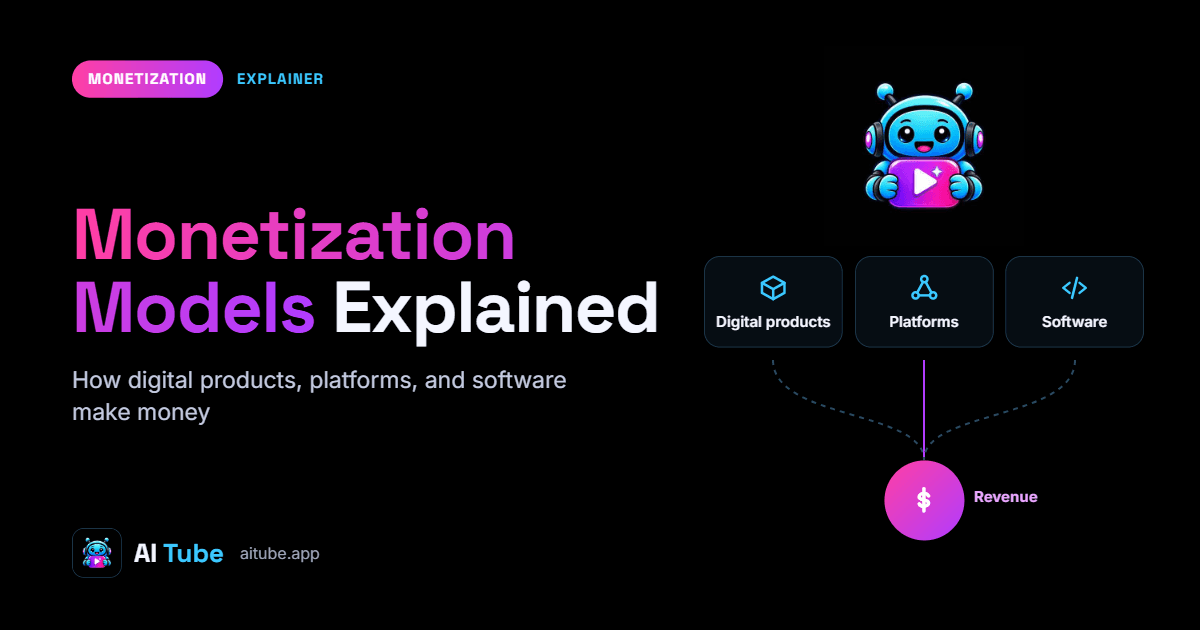
These approaches are known as monetization models. A monetization model explains how a company earns money from the value it provides. A monetization strategy goes further by explaining which customers the business will serve, what it will charge for, how pricing will work, and how revenue will grow over time.
Understanding different monetization models is useful for software companies, AI startups, mobile app developers, content creators, and digital platforms. This guide explains the main models, provides examples, and shows how to select an approach that fits your product.
What Does Monetization Mean?
Monetization means converting an asset, product, service, audience, or capability into revenue.
For example, a software company might monetize its product through monthly subscriptions. A video creator might earn through sponsorships or advertising. An API provider might charge developers for requests, while a marketplace might collect a fee from completed transactions.
Monetization in a sentence: “The company developed a monetization strategy that allows customers to use basic features for free and pay for advanced tools.”
Synonyms and related expressions include revenue generation, commercializing, generating income, and earning revenue. These terms are related but not always interchangeable. Commercialization, for example, can include the wider process of bringing a product to market, while monetization specifically focuses on generating revenue.
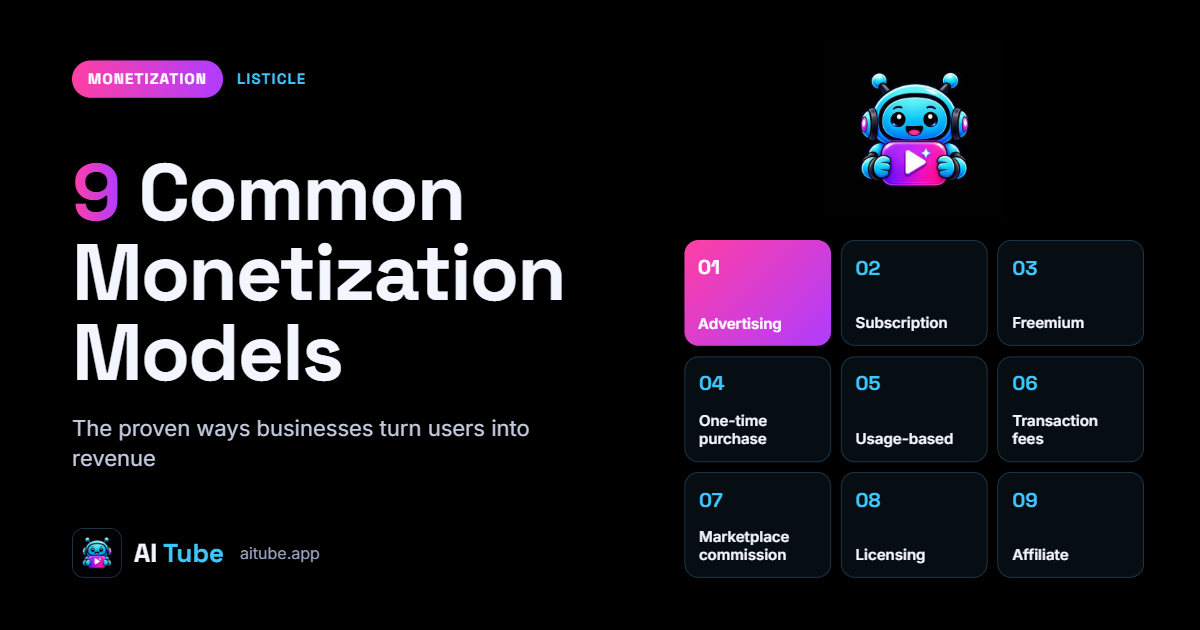
9 Common Monetization Models
1. Advertising monetization
Advertising monetization generates revenue by displaying paid advertisements to an audience. Websites, mobile apps, video platforms, and social networks may use this approach.
Revenue can depend on impressions, clicks, advertiser demand, audience location, engagement, and the advertising agreement.
Example: A free video platform displays eligible advertisements and shares a portion of the revenue with qualifying creators.
Best suited for: Products with meaningful audience reach and regular usage.
Main challenge: Too many advertisements can damage the user experience, while limited advertiser demand can make revenue unpredictable.
2. Subscription monetization
A subscription model charges customers recurring fees for continued access to a product, service, or content library.
Software-as-a-service businesses commonly use monthly or annual subscriptions. Subscription plans may differ by features, usage limits, storage, number of users, or support.
Example: A project management platform offers a free plan for individuals and paid plans for teams that need collaboration features.
Best suited for: Products that provide ongoing value.
Main challenge: Keeping customers engaged and reducing cancellations.
3. Freemium monetization
Freemium combines free access with paid upgrades. The free version helps customers try the product, while paid plans provide additional functionality or capacity.
The free offering should be genuinely useful. The paid tier should provide benefits that are relevant enough to justify the price.
Example: A video editing tool offers basic editing features and charges for additional capabilities or higher usage limits.
Freemium can support customer acquisition, but businesses need to monitor the cost of serving free users and the percentage who eventually upgrade.
4. Transaction and commission monetization
A business earns a fee when customers complete a transaction through its platform. The fee may be a fixed amount, a percentage of the transaction, or a combination of both.
Example: An online marketplace collects a commission when a buyer purchases a product from a seller.
This model works when the platform helps participants discover each other, complete transactions, or access services. Its success depends on transaction volume, customer trust, payment reliability, and a clear fee structure.
5. Product monetization
Product monetization involves generating revenue from a product’s features, functionality, or related services.
Digital products may use one-time purchases, subscriptions, usage credits, premium upgrades, or bundled plans. Physical products may generate additional revenue through accessories, maintenance, warranties, or complementary services.
A good product monetization strategy identifies the features customers value most and builds pricing around those benefits.
6. Software licensing monetization
Software licensing allows customers to pay for permission to use software under defined terms. Depending on the agreement, pricing may be based on users, devices, duration, features, or business requirements.
Licensing can suit specialist software, enterprise applications, and products that customers install or deploy in particular environments.
Companies should make license terms, renewal conditions, usage rights, and restrictions clear. Technical license enforcement should also be reliable and proportionate.
7. API monetization
An application programming interface (API) allows software systems to communicate or access specific functionality. API monetization means charging customers for using that capability.
Common approaches include:
Charging per API request.
Offering monthly plans with request limits.
Selling usage tiers.
Charging for access to premium endpoints or features.
Combining a base subscription with additional usage fees.
Example: A business provides an address-verification API and charges customers according to the number of requests processed.
A successful API monetization strategy needs dependable service, clear documentation, accurate usage measurement, and transparent pricing. Developers should be able to estimate costs before integrating the API into their applications.
8. Data monetization
Data monetization creates business value from data, either directly through permitted data products or indirectly through analysis and improved decisions.
Examples include aggregated market insights, retail demand forecasting, business intelligence reports, and analytics services.
However, collecting data does not automatically mean it can be sold or reused. Companies must consider consent, contracts, intellectual property, confidentiality, security, and applicable privacy laws.
A responsible data monetization strategy prioritizes legitimate use, data minimization, transparency, and appropriate safeguards. In many cases, providing useful analysis is more appropriate than transferring raw personal data.
9. Usage-based monetization
Usage-based monetization charges customers according to their consumption of a service. The pricing metric might be storage, transactions, processing time, API requests, generated media, or another measurable unit.
This approach can be suitable for cloud services, developer tools, and AI applications where usage varies significantly.
Its main advantage is flexibility: customers can start with low usage and pay more as their needs grow. Its main challenge is predictability. Businesses should provide usage dashboards, alerts, clear rates, and spending controls.
For more detail, see Stripe’s guide to usage-based billing models.
How to Choose the Right Monetization Model
There is no single model that works for every product. Use these questions to narrow down your options.
Who is the paying customer?
Determine whether you serve individual consumers, professional creators, small businesses, developers, or enterprise customers. Their budgets, purchasing processes, and expectations may differ significantly.
What value does the product provide?
Customers should understand what they receive in exchange for payment. A productivity tool might save time, an API might automate a process, and a creator platform might provide tools for publishing and developing an audience.
The closer the price is connected to recognizable customer value, the easier it can be to explain.
How often do customers use the product?
Frequent, ongoing use may support a subscription. Occasional use may suit one-time purchases or credits. Variable business workloads may benefit from usage-based pricing.
What are the costs of delivering the service?
Calculate infrastructure, hosting, customer support, payment processing, content delivery, AI processing, and other relevant costs. Revenue is not the same as profit, so a model that attracts customers may still be unsustainable if delivery costs are too high.
How predictable should revenue be?
Subscriptions can make revenue easier to forecast, while transaction and usage-based models may fluctuate. Hybrid models can combine recurring access with variable charges.
The right choice balances customer expectations, operating costs, and the company’s growth goals.
What Is a Monetization Platform?
A monetization platform is a system that helps a business manage one or more revenue streams. Depending on the product, it might support advertising, subscription management, billing, payment processing, creator payouts, access control, or revenue reporting.
Before choosing a monetization solution, check whether it supports your business model, payment methods, target countries, integrations, reporting requirements, and security needs.
A video platform, for example, may need publishing tools and creator revenue features. A SaaS company may need recurring billing and usage metering. A developer API provider may need accurate request tracking and automated invoicing.
Do not choose a platform solely because it offers many features. Choose one that solves your actual operational requirements.
Monetization Strategies for AI and SaaS Products
AI and SaaS businesses often combine several monetization models.
A company might provide free access to help users evaluate a product, charge subscriptions for ongoing access, and sell additional credits for resource-intensive tasks. Enterprise customers may receive separate plans with administrative controls or support options.
For generative AI software, pricing should reflect differences in resource consumption without making costs confusing. Clear limits, usage tracking, and billing notifications help customers make informed decisions.
AITube is an AI-powered video and creator platform built around creating, watching, and earning. Visitors can explore AITube and the available tools in AITube AI Studio. It is a relevant example of an AI-driven creator ecosystem, but users should check the current product terms and monetization requirements before assuming a particular feature or revenue opportunity is available.
Data Privacy and Monetization: What Businesses Should Consider
Data-driven business models require particular care because data can include personal, confidential, or commercially sensitive information.
Before monetizing data, businesses should:
Identify what data they collect and why.
Establish an appropriate legal basis for processing.
Explain relevant uses clearly to customers.
Limit access to authorized people and systems.
Protect data with appropriate security controls.
Set retention periods and deletion procedures.
Review contracts, third-party sharing, and applicable regulations.
Aggregated or de-identified information can reduce some privacy risks, but it is not automatically risk-free. The ability to re-identify people, combine datasets, or infer sensitive information should be considered.
Responsible data practices help protect customers and reduce the risk of reputational and legal problems.
How to Measure Monetization Performance
After selecting a model, define the metrics that show whether it is working.
Conversion rate: The percentage of a defined audience that completes a desired action.
Average revenue per user (ARPU): Revenue during a period divided by the defined user base for that period.
Customer acquisition cost (CAC): The cost of acquiring a customer, based on the expenses included in your calculation.
Retention rate: The proportion of users who remain active over a defined period.
Churn rate: The proportion of customers or revenue lost over a defined period, depending on the metric.
Gross margin: Revenue minus the direct costs included in the calculation, expressed as a percentage of revenue.
Lifetime value (LTV): An estimate of the value generated by a customer over the relationship, using a clearly defined revenue or profit measure.
Use consistent definitions and time periods. A higher conversion rate does not necessarily mean a healthier business if customers cancel quickly or delivery costs exceed revenue.
Conclusion
Monetization models define how digital products and services generate revenue. Advertising, subscriptions, freemium access, licensing, commissions, API pricing, data products, and usage-based billing each serve different business needs.
The strongest approach is not necessarily the one with the most revenue options. It is the model that matches customer value, supports delivery costs, respects privacy, and creates a sustainable business. Start with a clear value proposition, select a practical pricing structure, measure the results, and improve the model as your product and audience grow.